Between Ideology and Utopia
Re-thinking Conflict and Reconciliation in Psychotherapy
DOI:
https://doi.org/10.65828/4cngxb93Keywords:
conflict, reconciliation, ideology, utopia, RicoeurAbstract
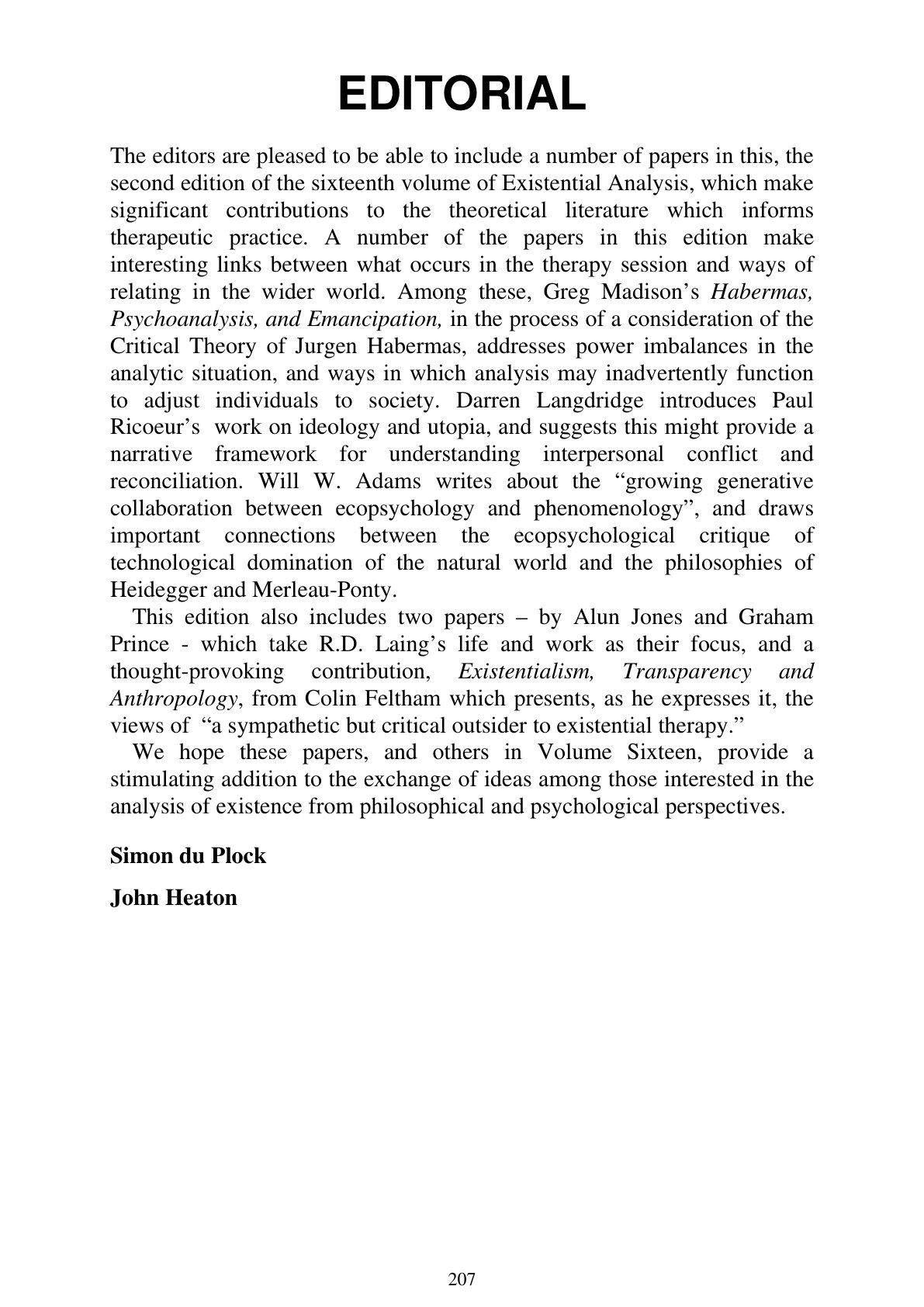
Conflict is a recurring theme in psychotherapy much as it is in everyday life. In this paper, I seek to introduce the reader to Ricoeur's work on ideology and utopia and suggest that this might form an alternative, though not exclusive, narrative framework (or critical hermeneutic) for understanding interpersonal conflict and reconciliation. Ricoeur's work on ideology and utopia is unusual for a number of reasons. In particular, it is one of the few attempts to conceptually draw ideology and utopia together within a common framework and develop a social theory where man remain centre-stage and not resigned to being nothing more than a pawn of prevailing economic forces. Drawing on this conceptual foundation, I argue that the interpersonal conflict we encounter between clients might best be resolved by engaging such clients in utopian imaginings and the active re-construction of narrative identities for self and other.
Complete access to the full archive of articles is available with SEA membership. Existing members: please log in with your membership password to view full text. Non-members can buy a single article or issue by registering an account on this website, then selecting a padlocked full text button to purchase.
References
Boulding, E. (2000). Cultures of peace: The hidden side of history. New York: Syracuse University Press. DOI: https://doi.org/10.2307/jj.35615674
Brown, D. and Pedder, J. (1991). Introduction to Psychotherapy: An Outline of Psychodynamic Principles and Practice. 2nd Ed. London: Routledge. DOI: https://doi.org/10.4324/9780203978207
Ciarlo, D.D. (2001). Transforming 'swords' into 'plowshares': Images and stories. Invited address to the Peace Psychology Division (48), APA Convention, San Francisco, CA, August.
Dauenhauer, B.P. (1998). Paul Ricoeur: The Promise & Risk of Politics. Lanham, Maryland: Rowman & Littlefield.
Foucault, M. (1970). The Order of Things. London: Tavistock. DOI: https://doi.org/10.4324/9780203996645
Foucault, M. (1971). Madness and Civilisation; A History of Insanity in the Age of Reason. London: Tavistock. DOI: https://doi.org/10.2307/2799941
Foucault, M. (1972). The Archaeology of Knowledge. London: Tavistock. DOI: https://doi.org/10.4324/9780203604168
Geertz, C. (1973). The Interpretation of Cultures. New York: Basic Books.
Hewstone, M. and Stroebe, W. (eds) (2001). Introduction to Social Psychology. 3rd Ed. Oxford: Blackwell.
Laing, R.D. and Cooper, D.G. (1971). Reason and Violence. 2nd Ed. London: Tavistock Publications.
Mannheim, K. (1936). Ideology and Utopia. Trans. Worth, L. and Shils, E. New York: Harcourt, Brace and World.
Marx, K. and Engels, F. (1970). The German Ideology. Arthur, C.J. (ed.) and Intro. London: Lawrence & Wishart.
McLeod, J. (1997). Narrative and Psychotherapy. London: Sage. DOI: https://doi.org/10.4135/9781849209489
Ricoeur, P. (1984). The Creativity of Language. Interview with Richard Kearney. Reprinted in Valdes, M.J. (ed) (1991). A Ricoeur Reader: Reflection and Imagination. Toronto, Canada: University of Toronto Press. DOI: https://doi.org/10.3138/9781442664883
Ricoeur, P. (1986). Lectures on Ideology and Utopia. Taylor, G.H. (ed). New York: Columbia University Press.
Sartre, J.P. (1963). Saint Genet: Actor and Martyr. London: W. H. Allen. DOI: https://doi.org/10.1017/cbo9780511779497.009
Sartre, J.P. (1963/1968). Search for a Method. Trans. Barnes, H. New York: Vintage Books.
Sartre, J. P. (1976/2004). Critique of Dialectical Reason. Vol. 1. Trans. Sheridan-Smith, A. London: Verso. DOI: https://doi.org/10.1017/cbo9780511779497.008
Tantam, D. (2002). Psychotherapy and Counselling in Practice: A Narrative Framework. Cambridge: Cambridge University Press. DOI: https://doi.org/10.1017/cbo9780511544323
Weber, M. (1986). Economy and Society. Roth, G. and Wittich, C. (eds). Berkeley: University of California Press. [First published 1968]. DOI: https://doi.org/10.4159/9780674240827
White, M. and Epston, D. (1990). Narrative Means to Therapeutic Ends. New York: Norton.