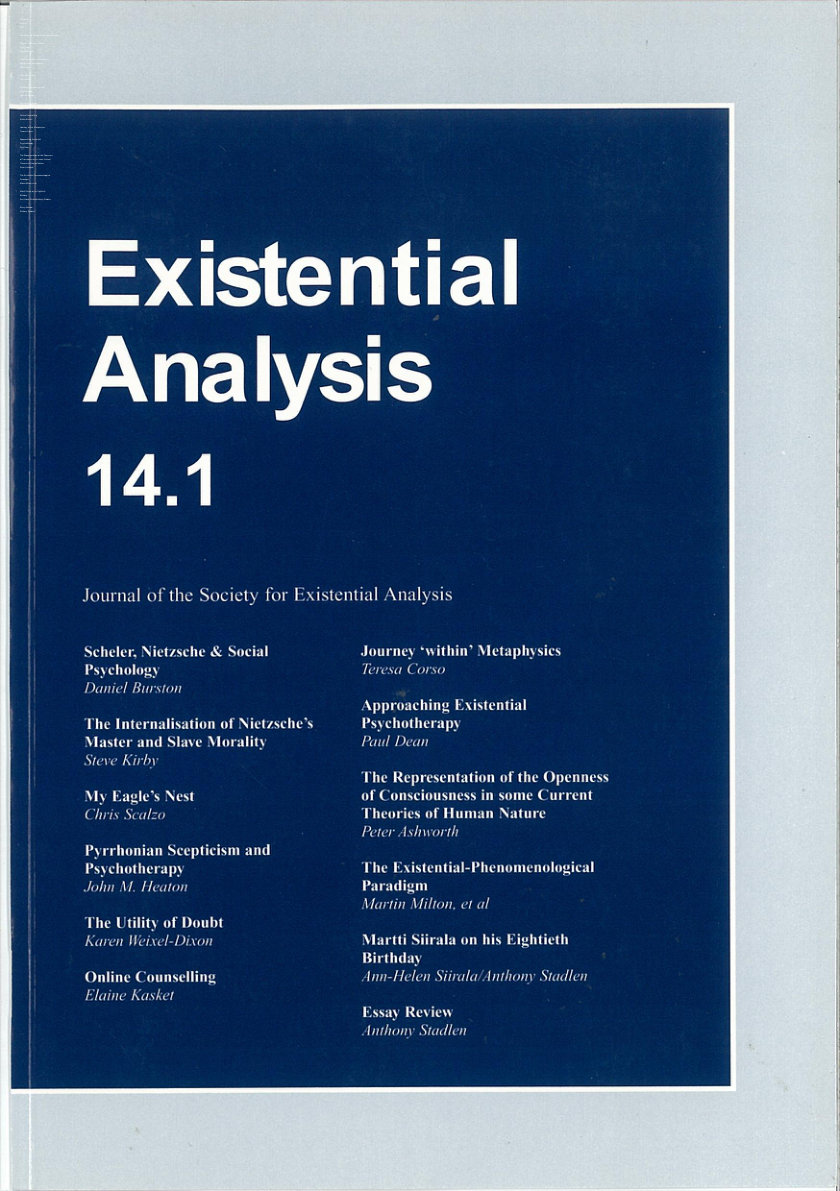
The Existential-Phenomenological Paradigm: The Importance for Psychotherapy Integration
DOI:
https://doi.org/10.65828/z7m6mr20Abstract
Psychotherapy integration is currently an area of huge interest for those professions that deem themselves scientist-practitioners – this of course includes counselling psychology. At a theoretical level we can see a range of texts exploring and presenting models of integration (Palmer and Woolfe, 2000; Ryle, 1990). At the level of service delivery we see a range of government directives indicating that psychologists need to consider integration as the 'thread and butter approach' to mental health services with 'Level B' forms of psychotherapy predominating (NHSE, 1996). The complexity of these literatures provides many a challenge for the training of clinical and counselling psychologists and the practice of psychological therapies. This paper describes the phenomenology of several counselling psychologists as they rose to the challenges of the complex task of integration – as a trainer and as trainees.
Complete access to the full archive of articles is available with SEA membership. Existing members: please log in with your membership password to view full text. Non-members can buy a single article or issue by registering an account on this website, then selecting a padlocked full text button to purchase.
References
Arkowitz, H. (1992). Integrative Theories of Therapy. In D.K. Freedheim (Ed.), History of Psychotherapy: A Century of Change. Washington DC: American Psychological Association. DOI: https://doi.org/10.1037/10110-007
Beck, A.T., Freeman, A., and Associates. (1990). Cognitive Therapy of Personality Disorders. New York: Guilford Press.
Beck, J.S. (1995). Cognitive Therapy: Basics and Beyond. New York: Guilford.
Blackburn, I. & Twaddle, V. (1996). Cognitive Therapy in Action. London: Souvenir.
Boss, M. (1957). The Analysis of Dreams. London: Rider.
Boss, M. (1977). I Dreamt Last Night. New York: Gardner.
Buber, M. (1970). I and Thou (W. Kaufmann, trans.). Edinburgh: T. & T. Clark
Burr, V. (1995). Introduction to Social Constructionism. London: Routledge. DOI: https://doi.org/10.4324/9780203299968
Campbell, J. (1988). The Power of Myth. London: Doubleday.
Clarkson, P. (1995). The Therapeutic Relationship. London: Whurr.
Clarkson, P. (1997) Integrative Psychotherapy, Integrating Psychotherapies or Psychotherapy after 'Schoolism', C. Feltham (Ed) Which Psychotherapy? London: Sage.
Clarkson, P. & Pokorny, M. (1994). The Handbook of Psychotherapy. London: Routledge. DOI: https://doi.org/10.4324/9781315800264
Cohn, H. (1997). Existential Thought and Therapeutic Practice. London: Sage.
Corrie, S. and Milton, M. (2000). The relationship between existential-phenomenological and cognitive-behaviour therapies. European Journal of Psychotherapy, Counselling and Health, 3 (1): 7-24. DOI: https://doi.org/10.1080/13642530050078538
Coyle, A. (2001) personal communication.
Davison, G.C. & Neale, J.M. (1974) Abnormal Psychology. Chichester: John Wiley & Sons.
Deurzen, E. van (1998). Paradox and Passion in Psychotherapy: An Existential Approach to Therapy and Counselling. Chichester: Wiley.
Deurzen, E. van (1994). Courting Death: Mortal Ambitions of Existential Analysis, Journal of the Society for Existential Analysis, 5.
Deurzen-Smith, E. van (1988). Existential Counselling in Practice. London: Sage.
Deurzen-Smith E. van (1990) Existential Therapy, In W. Dryden (Ed.), Individual Therapy: A Handbook. Open University Press; Milton Keynes.
Deurzen-Smith, E. van (1995) Existential Therapy. The Society for Existential Analysis..
Deurzen-Smith, E. van. (1997). Everyday Mysteries: Existential Dimensions of Psychotherapy. London: Routledge.
Division of Counselling Psychology. (1995). Guidelines for the Professional Practice of Counselling Psychology. Leicester, British Psychological Society. DOI: https://doi.org/10.53841/bpsrep.2005.rep75
Division of Counselling Psychology. (1998). Guidelines for the Professional Practice of Counselling Psychology. Leicester, British Psychological Society. DOI: https://doi.org/10.53841/bpsrep.2005.rep75
du Plock, S. (1993). Dialogue or diatribe? A brief comparison of the implications for client-therapist interactions of existential and cognitive analytic approaches. Journal of the Society for Existential Analysis, 4: 91-107. DOI: https://doi.org/10.65828/mn9pd655
du Plock, S. (ed). (1997). Case Studies in Existential Psychotherapy and Counselling. Chichester: Wiley.
Edwards, D. (1990). Cognitive-behavioral and existential-phenomenological approaches to therapy: complementary or conflicting paradigms? Journal of Cognitive Psychotherapy, 4, 2, 105-119. DOI: https://doi.org/10.1891/0889-8391.4.2.105
Fear, R. & Woolfe, R. (2000). The Personal, the Professional and the Basis of Integrative Practice. In S. Palmer & R. Woolfe (Eds.), Integrative and Eclectic Counselling and Psychotherapy (pp. 329-340). London: Sage. DOI: https://doi.org/10.4135/9781446280409.n19
Frank, J.D. (1973). Persuasion and Healing, (2nd ed.). Baltimore: John Hopkins University Press. DOI: https://doi.org/10.56021/9781421451374
Goldfried, M.R. & Gastonguay, L.G. (1992). The future of psychotherapy integration. Psychotherapy, 29(1), 4-10. DOI: https://doi.org/10.1037/0033-3204.29.1.4
Goncalves, O.F. (1995). From epistemological truth to existential meaning in cognitive narrative psychotherapy. Journal of Constructivist Psychology, 7, 107-118.
Guidano, V.F. (1991). The Self in Process: Towards a Post-rationalist Cognitive Therapy. New York: Guilford.
Guidano, V.F., and Liotti, G. (1983). Cognitive Processes and Emotional Disorders: A Structural Approach to Psychotherapy. New York: Guilford.
Handley, N. (1995) The concept of transference: A critique. British Journal of Psychotherapy, 12 (1), 49-59. DOI: https://doi.org/10.1111/j.1752-0118.1995.tb00782.x
Heidegger, M. (1927). Being and Time. Translated by Macquarrie, J. & Robinson, E.S. 1962. London: Harper and Row.
Hollanders, H. (2000). Eclecticism/Integration: Some Key Issues and Research. In S. Palmer & R. Woolfe (Eds.), Integrative and Eclectic Counselling and Psychotherapy London: Sage. DOI: https://doi.org/10.4135/9781446280409.n2
Honderich, T. (1995). The Oxford Companion to Philosophy. Oxford: Oxford University Press. DOI: https://doi.org/10.1093/acref/9780199264797.001.0001
Husserl, E. (1913). Ideas (transl. W.R. Boyce Gibson). New York: Macmillan, 1931 ed.
Husserl, E. (1925). Phenomenological Psychology (trasl. J. Scanlon). The Hague: Martinus Nijhoff, 1977 ed. DOI: https://doi.org/10.1007/978-94-010-1083-2
Judd, D. (2001). An existential-phenomenological critique of transference. Counselling Psychology Review, 16 (1) 28-32. DOI: https://doi.org/10.53841/bpscpr.2001.16.1.28
Judd, D. & Milton, M. (2001). Psychotherapy with lesbian and gay clients: existential-phenomenological contributions to training. Lesbian and Gay Psychology Review, 2(1): 16-23. DOI: https://doi.org/10.53841/bpslg.2001.2.1.16
Jung, C.G. (1966). The Psychology of the Transference, pp.161-332 in The Collected Works, vol.16. London: Routledge & Kegan Paul (first published in 1946). DOI: https://doi.org/10.1515/9780691218403
Kaam, A. van (1963). Existential psychology as a comprehensive theory of personality. Review of Existential Psychology and Psychiatry, 8, 1.
Kierkegaard, S. (1844). The Concept of Dread (transl. W. Lowrie). Princeton: Princeton University Press, 1944 ed.
Lemma-Wright, A. (1997). The Invisible scar – Psychotherapy with a head-injured client, in S. du Plock (ed) Case Studies in Existential Psychotherapy and Counselling, Chichester: Wiley.
Liotti, G. (1987). The resistance to change of cognitive structures: a counterproposal to psychoanalytic metapsychology. Journal of Cognitive Psychotherapy. 2. 87-104.
Liotti, G. (1991). Patterns of attachments and the assessment of interpersonal schemata: Understanding and changing difficult patient-therapist relationships in cognitive psychotherapy. Journal of Cognitive Psychotherapy: An International Quarterly. 5. 105-114. DOI: https://doi.org/10.1891/0889-8391.5.2.105
Moja-Strasser, L. (1997). The Climber: Dreaming and its Therapeutic Value, in S. du Plock (ed). Case Studies in Existential Psychotherapy and Counselling. Chichester: Wiley.
National Health Service Executive, (1996). NHS Psychotherapy Services in England: Review of Strategic Policy. Leeds: Dept of Health.
Neirneyer, R.A. & Morton, R.J. (1997). Personal epistemologies and preferences for rationalist versus constructivist psychotherapies. Journal of Constructivist Psychology, 10, 109-123. DOI: https://doi.org/10.1080/10720539708404616
Nietzsche, F. (1882) The Gay Science. Trans. Kaufmann, W. 1974. New York: Random House.
Norcross, J.C. (1986). Handbook of Eclectic Psychotherapy. New York: Brunner/Mazel.
Norcross, J.C. & Newman, C.F. (1992). Psychotherapy Integration: Setting the Context. In J.C. Norcross & M.R. Goldfried (Eds.), Handbook of Psychotherapy Integration. New York: Basic Books. DOI: https://doi.org/10.1093/med-psych/9780190690465.001.0001
Orlinsky, D.E. & Howard, K.I. (1986). Process and Outcome in Psychotherapy. In S.L. Garfield & A.E. Bergin (Eds.) Handbook of Psychotherapy and Behaviour Change, 3rd ed. New York: Wiley.
Ottens, A.J. & Hanna, F.J. (1998). Cognitive and existential therapies: Towards an integration. Psychotherapy, 33(3), 312-324. DOI: https://doi.org/10.1037/h0087832
Palmer, S., and Wolfe, R. (2000). Integrative and Eclectic Counselling and Psychotherapy. London: Sage. DOI: https://doi.org/10.4135/9781446280409
Persons, J.B. (1989). Cognitive Therapy in Practice: A Case Formulation Approach. New York: Norton. DOI: https://doi.org/10.1016/j.cbpra.2022.02.014
Power, M. & Brewin, C. (1997). The Transformation of Meanings. Chichester: Wiley.
Rogers, C. R. (1959). A Theory of Therapy, Personality and Interpersonal Relationships as Developed in the Client-Centred Framework. In S. Koch (Ed.), Psychology: Vol. 3. A Study of Science. Formulation of the Person in the Social Context. New York: McGraw Hill.
Roth, A. & Fonagy, P. (1996). What Works for Whom? A Critical Review of Psychotherapy Research. London, Guilford Press.
Rowan, J. (1999). Existential analysis and humanistic psychotherapy. Journal of the Society for Existential Analysis, 10(1): 20-26. DOI: https://doi.org/10.65828/p7bahj11
Rugala, S.A. & Waldo, M. (1998). An integration of existential psychology and the multimodal model. Journal of Humanistic Psychology, 38(4), 65-79. DOI: https://doi.org/10.1177/00221678980384005
Ryle, A. (1990) Cognitive-Analytic Therapy: Active Participation in Change – A New Integration in Brief Psychotherapy. Wiley: Chichester.
Safran, J.D., and Segal, Z.V. (1990). Interpersonal Processes in Cognitive Therapy. New York: Basic Books.
Salkovskis, P.M. (1996). Frontiers of Cognitive Therapy. New York: Guilford.
Samuels, A. (1997). Pluralism and the Future of Psychotherapy, S. Palmer and V. Varma (Eds). The Future of Counselling and Psychotherapy, London: Sage.
Sartre, J.P. (1943). Being and Nothingness: An Essay on Phenomenological Ontology. Translated by Barnes, H. 1958, London: Routledge. DOI: https://doi.org/10.4324/9780429434013
Sartre, J.P. (1946). Existentialism and Humanism. Translated by Mairet, P. 1948, London: Routledge.
Schneider, K.J. & May, R. (1995). The Psychology of Existence. New York: McGraw-Hill.
Smith, D.L. (1994). Riding shotgun for Freud: A reply to Ernesto Spinelli. Journal of the Society for Existential Analysis, 5. DOI: https://doi.org/10.65828/z97n4d70
Smith, D. L. (1995). 'It sounds like an excellent idea!': Episode four of a psychological cliff-hanger. Journal of the Society for Existential Analysis, 6(1):; 6(1): 149-159. DOI: https://doi.org/10.65828/9tz7nv67
Spinelli, E. (1989). The Interpreted World: An Introduction to Phenomenological Psychology. London: Sage Publications.
Spinelli, E. (1994a). Demystifying Therapy. London: Constable,
Spinelli, E. (1994b) The Unconscious: An Idea Whose Time Has Gone? Journal of the Society for Existential Analysis, 4: 19-47. DOI: https://doi.org/10.65828/aat43x68
Spinelli, E. (1995a). '...Too bad it turned out the way it did': A further response to David L. Smith. Journal of the Society for Existential Analysis, 6(1):160-167. DOI: https://doi.org/10.65828/9h3m0p97
Spinelli, E. (1995b). Riding shotgun for Freud or aiming a gun at his head? A reply to David Smith, Journal of the Society for Existential Analysis, 5. DOI: https://doi.org/10.65828/cdygpy60
Spinelli, E. (1995c). An Existential-Phenomenological Counter-theory of Transference. Counselling Psychology Quarterly, 8(4): 269-277. DOI: https://doi.org/10.1080/09515079508599587
Spinelli, E. (1995d). On disclosure. Journal of the Society for Existence. Analysis, 6.1:2-19. DOI: https://doi.org/10.65828/0yxzwq38
Spinelli, E. (1996). The Existential-Phenomenological Paradigm. In Woolfe, R. & Dryden, W. (Eds) Handbook of Counselling Psychology, pp. 180-200. London: Sage Publications.
Spinelli, E. (1997). Tales of Un-knowing: Therapeutic Encounters from an Existential Perspective. London: Duckworth.
Spinelli, E. (1999). An open letter to John Rowan in reply to his article 'Existential analysis and humanistic psychotherapy'. Journal of the Society for Existential Analysis, 10(1): 65-71. DOI: https://doi.org/10.65828/8g47pv45
Strasser, F. (1999). Emotions: Experiences in Existential Psychotherapy and Life. London: Duckworth.
Strasser, F. & Strasser, A. (1997). Existential Time Limited Therapy: The Wheel of Existence, Chichester; Wiley.
Todres, L (1990). The rhythm of psychotherapeutic attention: A training model. Journal of Phenomenological Psychology, 21: 32-45. DOI: https://doi.org/10.1163/156916290x00100
Vandenberg, B. (1991). Is epistemology enough? An existential consideration of development. American Psychologist, 46, 1278-1286. DOI: https://doi.org/10.1037//0003-066x.46.12.1278
Vincent, N. & Lebow, M. (1995). Treatment preference and acceptability: Epistemology and locus of control. Journal of Constructivist Psychology, 8, 81-96. DOI: https://doi.org/10.1080/10720539508405244
Wills, F. & Sanders, D. (1997). Cognitive Therapy: Transforming the Image. London: Sage.
Yalom, I.D. (1980). Existential Psychotherapy. New York: Basic Books.
Yalom, I.D. (1995). The Theory and Practice of Group Psychotherapy, 4th ed. New York: Basic Books.
Yalom, I.D. and Elkins, G. (1974). Everyday Gets a Little Closer: A Twice-Told Therapy. New York: Basic books.
Young, J.E. (1994). Cognitive Therapy for Personality Disorders: A Schema Focused Approach. Sarasota, FL.: Professional Resource Press.