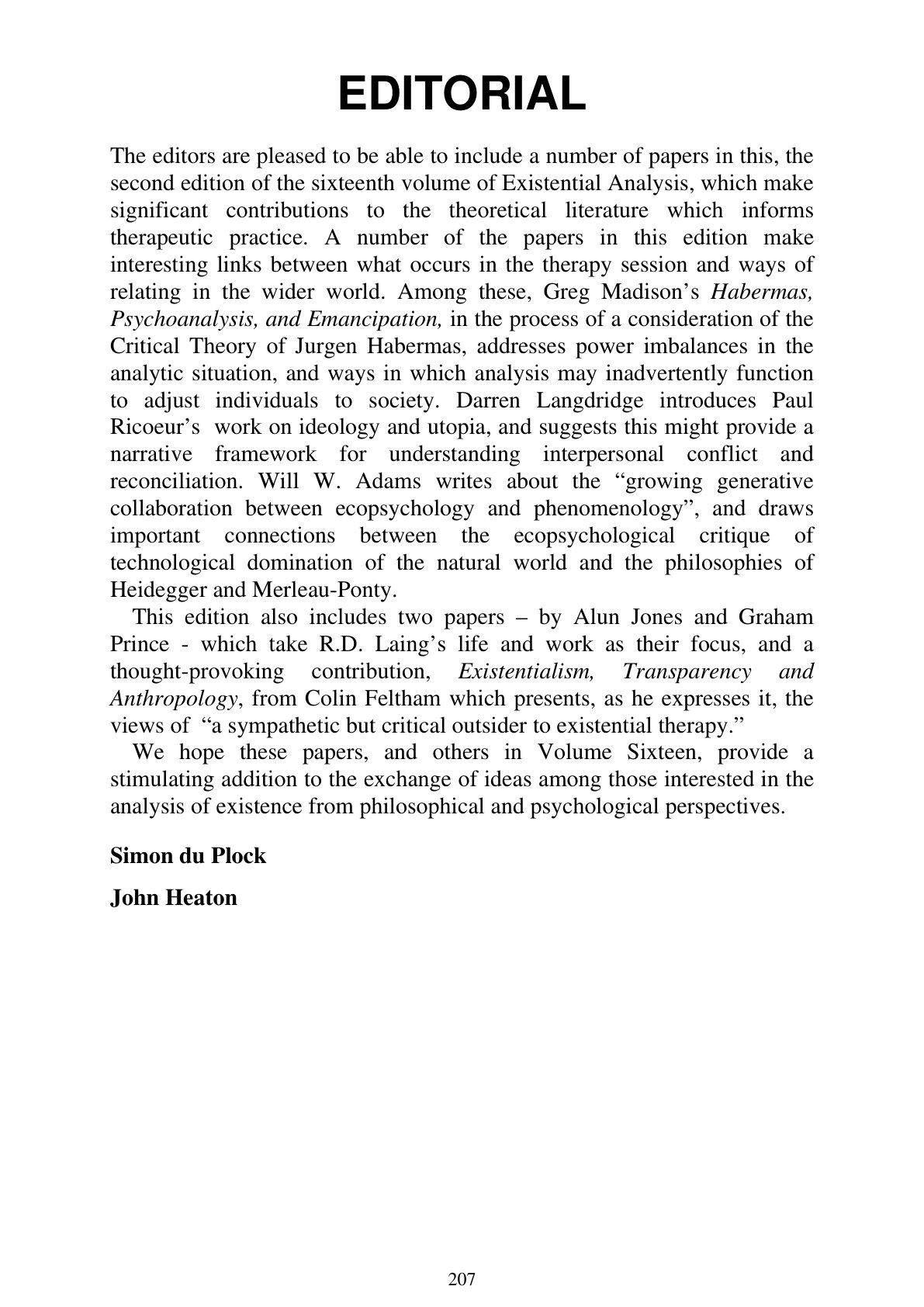
Existentialism, Transparency and Anthropathology
DOI:
https://doi.org/10.65828/329kpc93Keywords:
transparency, anthropopathology, worldview as pathologyAbstract
The views of a sympathetic but critical outsider to existential therapy are outlined. An alternative explanation for human alienation is briefly considered. The loss of transparency in contemporary discourse is lamented and some examples from my own life are given. Connections between one's worldview and possible underlying pathology are explored.
Complete access to the full archive of articles is available with SEA membership. Existing members: please log in with your membership password to view full text. Non-members can buy a single article or issue by registering an account on this website, then selecting a padlocked full text button to purchase.
References
Adamson, B. (2004). What's Wrong With Right Now? (2nd edn.). Salisbury: Non-duality Press.
Batchelor, S. (2004). Living with the Devil: A Meditation on Good and Evil. New York: Riverhead.
Bohm, D. (1992). Thought as a System. London: Routledge.
Calder, J. (2003). The Philosophy of Samuel Beckett. London: Calder Publications.
Camus, A. (2000). The Myth of Sisyphus. Trans. O'Brien, J. London: Penguin.
Cohen, S. and Taylor, L. (1992). Escape Attempts: The Theory and Practice of Resistance to Everyday Life (2nd edn.). London: Routledge. DOI: https://doi.org/10.4324/9780203205549
Dittman,- Kohli, F. and Westerhof, G.J. (2000). The personal meaning system in a lifespan perspective. In Reker, G.T. and Chamberlain, K. (eds). Exploring Existential Meaning: Optimizing Human Development Across the Lifespan. Thousand Oaks, CA: Sage. DOI: https://doi.org/10.4135/9781452233703.n8
Drees, W.B. (ed) (2003). Is Nature Ever Evil? Religion, Science and Value. London: Routledge. DOI: https://doi.org/10.4324/9780203398173
Emmons, R.A. (1999). The Psychology of Ultimate Concerns: Motivation and Spirituality in Personality. New York: Guilford.
Feltham, C. (2004a). Problems Are Us: Or Is It Just Me? Felixstowe: Braiswick.
Feltham, C. (2004b). From Pollyannaish to Beckettian therapies: the search for mental health. Eisteach, 3 (2), 1 – 5.
Feltham, C. (1998). In search of meaning and sanity. In C. Feltham (ed). Witness and Vision of the Therapists. London: Sage.
Feltham, C. (1997). Challenging the core theoretical model. Counselling, 8 (2), 121 – 125.
Gray, J. (2004). Heresies: Against Progress and Other Illusions. London: Granta.
Gray, J. (2002). Straw Dogs: Thoughts on Humans and Other Animals. London: Granta.
Groth, M. (2001). The body that I am: lived body and existential change. In Spinelli, E. and Marshall, S. (eds) Embodied Theories. London: Continuum. DOI: https://doi.org/10.4135/9781446218013
Hannay, A. (2001). Kierkegaard: A Biography. Cambridge: Cambridge University Press. DOI: https://doi.org/10.1017/cbo9780511498152
Janov, A. (1975). The Primal Revolution. London: Abacus.
Janov, A. (1970). The Primal Scream. London: Abacus.
Jouarard, S. (1971). The Transparent Self. New York: D. Van Nostrand.
Krishnamurti, J. (1973). The Awakening of Intelligence. London: Gollancz.
Kaufmann, W. (ed) (1968). The Portable Nietzsche. New York: Penguin.
Lyotard, J-F. (1991). The Inhuman. Trans. Bennington, G. and Bowlby, R. Cambridge: Polity Press.
Marcel, G. (1949). The Philosophy of Existence. Trans. Harai, M. New York: Books for Libraries.
Marmysz, J. (2003). Laughing at Nothing: Humor as a Response to Nihilism. New York: State University of New York. DOI: https://doi.org/10.1353/book4718
Oden, T.C. (ed.) (2004). The Humor of Kierkegaard: An Anthology. Princeton, NJ: Princeton University Press. DOI: https://doi.org/10.1515/9780691216270
Ritzer, G. (2004). The Globalization of Nothing. Thousand Oaks, CA: Sage.
Sartre, J-P. (1967). Words. Trans. Clephane, I. Harmondsworth: Penguin.
Sartre, J-P. (1946). Existentialism is a humanism. Trans. Mairet, P. Lecture published in W. Kaufmann (ed). Existentialism from Dostoevsky to Sartre. New York: Meridian. (Accessed at www.marxists.org/reference/archive/sartre/works/exist on 08/02/2005.) DOI: https://doi.org/10.2307/401786
Szasz, T. (2005). What is existential therapy not? Existential Analysis, 16 (1), 127-130. DOI: https://doi.org/10.65828/2bxxgm34
Strasler, F. and Strasser, A. (1997). Existential Time-Limited Therapy: The Wheel of Existence. Chichester: Wiley. DOI: https://doi.org/10.1002/9781118713679
Taylor, S. (1989). Positive Illusions: Creative Self-Deception and the Healthy Mind. New York: Basic Books.
Tillich, P. (1962) The Courage To Be. London: Fontana. DOI: https://doi.org/10.12987/9780300170023
Van Deurzen, E. (1998). Paradox and Passion in Psychotherapy: An Existential Approach to Therapy and Counselling. Chichester: Wiley.
Weatherill, R. (1998). The Sovereignty of Death. London: Rebus.
Yare, B. (2005). Karl Jaspers' 'Communication in Existenz': Analysis and commentary. Existential Analysis, 16 (1), 36 – 49. DOI: https://doi.org/10.65828/8eqy3547
Zerzan, J. (2002). Running on Emptiness: The Pathology of Civilization. Los Angeles, CA: Feral House.