Ecopsychology and Phenomenology
Toward A Collaborative Engagement
DOI:
https://doi.org/10.65828/9r6emy34Abstract
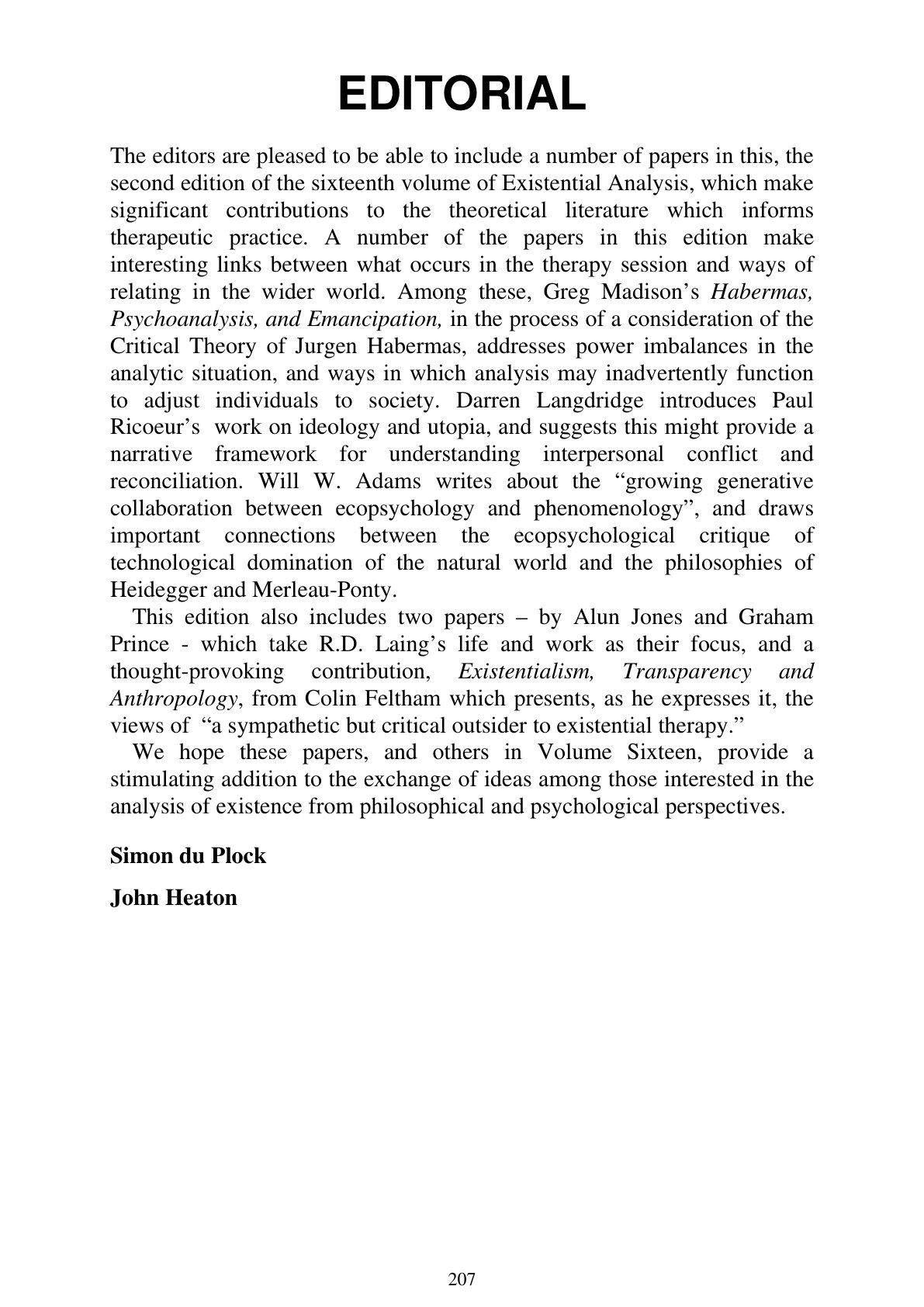
This study is an offering in the growing generative collaboration between ecopsychology and phenomenology. Viewing our ecological peril as a crisis of consciousness and culture, ecopsychology works for a radical transformation of humankind's dissociative relationship with the other than human natural world. This article considers ecopsychology's critique of the modernist enterprise of gaining (supposed) security and power through technological domination of nature and economic expansion. Ecopsychology fosters movement beyond our exclusionary identification as ego-centered subjects; our belief in a real and inevitable dualistic separation of humans and nature; and our anthropocentric view of humans as the exclusive locus of meaning and value. Showing that these concerns are central for Heidegger and Merleau-Ponty, this study explores how the phenomenological tradition and ecopsychology can be powerful allies.
Complete access to the full archive of articles is available with SEA membership. Existing members: please log in with your membership password to view full text. Non-members can buy a single article or issue by registering an account on this website, then selecting a padlocked full text button to purchase.
References
American Psychiatric Association. (2000). Diagnostic and Statistical Manual of Mental Disorders, 4th Ed. Text Revision. Washington, DC: American Psychiatric Association. DOI: https://doi.org/10.1176/appi.books.9780890425787
Berry, W. (1998). The Selected Poems of Wendell Berry. Washington, DC: Counterpoint.
Beyer, J.D. (1999). Experiencing the Self as Being Part of Nature: A Phenomenological-Hermeneutical Investigation into the Discovery of the Self in and as the Flesh of the Earth. Ann Arbor, MI: UMI.
Fisher, A. (2002). Radical Ecopsychology. Psychology in the Service of Life. Albany, NY: SUNY Press. DOI: https://doi.org/10.1353/book4515
Gibson, L. (2002). Personal conversation, Kayford Mountain, WV.
Heidegger, M. (1967). Holderlin and the essence of poetry. In Brock, W. (ed). Existence and Being. (pp.270-291). Chicago: Gateway. (Original work published 1936).
Heidegger, M. (1966). Discourse on Thinking. Trans. Anderson, J. and H. Freund, H. New York: Harper and Row. (Original work published 1959).
Heidegger, M. (1977a). On the essence of truth. Trans. Sallis, J. In Krell, D.F. (ed). Martin Heidegger. Basic Writings (pp.117-141). New York: Harper and Row. (Original work published 1943). DOI: https://doi.org/10.2307/j.ctv3zp005.10
Heidegger, M. (1977b). The question concerning technology. Trans. Lovitt, W. In The Question Concerning Technology and Other Essays (pp.3-49). New York: Harper & Row. (Original work published 1954). DOI: https://doi.org/10.5040/9798216385448.ch-1
Heidegger, M. (1977c). The word of Nietzsche: "God is dead". Trans. W. Lovitt, W. In The Question Concerning Technology and Other Essays (pp. 54-112). New York: Harper & Row. (Original work published 1952).
Jackson, J. (2004). In Search of the Ivory-Billed Woodpecker. Washington, DC: Smithsonian Books.
Laing, R.D. (1967). The Politics of Experience. New York: Pantheon.
Leiss, W. (1972). The Domination of Nature. Boston: Beacon. DOI: https://doi.org/10.1515/9780773564794
Lopez, B. (1978). Of Wolves and Men. New York: Simon and Schuster.
Loy, D. (1996). Lack and Transcendence. The Problem of Death and Life in Psychotherapy, Existentialism, and Buddhism. Amherst, NY: Humanity Books.
Merchant, C. (1980). The Death of Nature. Women, Ecology, and the Scientific Revolution. San Francisco: Harper Collins.
Merchant, C. (1992). Radical Ecology. The Search for a Livable world. New York: Routledge. DOI: https://doi.org/10.4324/9780203084212
Merleau-Ponty, M. (1962). Phenomenology of Perception. Trans. Smith, C. London: Routledge and Kegan Paul. (Original work published 1945).
Merleau-Ponty, M. (1968). The Visible and the Invisible. Trans. Lingis, A. Evanston, IL: Northwestern University Press. (Original work published 1964).
Nabhan, G.P. and St. Antoine, S. (1993). The loss of floral and faunal story: The extinction of experience. In Kellert, S.R. and Wilson, E.O. (eds) The Biophilia Hypothesis. Washington, DC: Island Books. DOI: https://doi.org/10.2307/jj.40831413.11
Nelson, S. (1993). Searching for the lost arrow: Physical and spiritual ecology in the hunter's world. In Kellert, S.R. and Wilson, E.O. (eds). The Biophilia Hypothesis. Washington, DC: Island Books. DOI: https://doi.org/10.2307/jj.40831413.10
Ricoeur, P. (1967). The symbolism of evil. Trans. Buchanan, E. Boston: Beacon.
Wilber, K. (1980). The Atman Project. Wheaton, IL: Theosophical Publishing House.
Wilber, K. (2000). Sex, Ecology, Spirituality. The Spirit of Evolution. 2nd edition. Boston: Shambhala.
Williams, T. (2001). Mountain madness. Audubon Magazine, May-June 2001.
Zimmerman, M.E. (1986). Eclipse of the Self. The Development of Heidegger's Concept of Authenticity. Athens, OH: Ohio University Press.
Zimmerman, M.E. (1994). Contesting Earth's Future. Radical Ecology and Postmodernity. Berkeley: University of California Press. DOI: https://doi.org/10.1525/9780520919228