Habermas, Psychoanalysis, and Emancipation
DOI:
https://doi.org/10.65828/x9w17m49Abstract
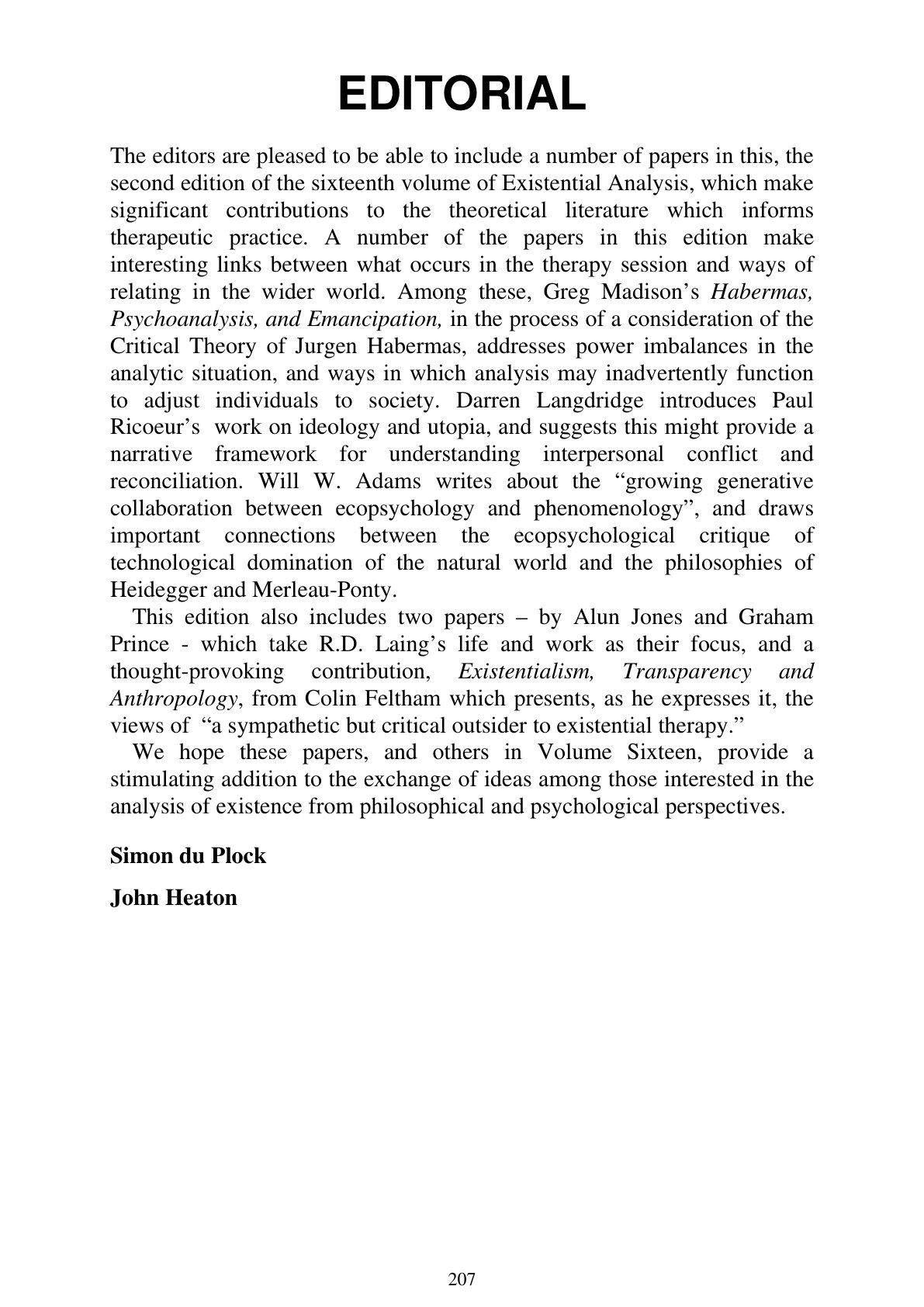
Jurgen Habermas asserts that all knowledge is based upon human values. He criticises the values which underlie (positivistic) empirical science and instead suggests that hermeneutics provide a more appropriate basis for human sciences. However, Habermas rejects ordinary hermeneutics for its tendency to reify tradition and language, and to assume that subjects are aware of the meaning of their actions. Instead Habermas proposes a Critical Theory which has the eradication of unnecessary oppression and the maximization of human emancipation as its value. Habermas chooses Psychoanalysis as the model for this project. The following paper sketches this development from empiricism through hermeneutics to psychoanalysis. Although psychoanalysis can be viewed as a type of "depth hermeneutics" it also embodies many characteristics of an empirical science. It is suggested that this may make it inappropriate for Habermas's task. However, the major problem is seen to be the power imbalance in the analytic situation, which leaves the analyst in charge of the interaction, interpretations, and possible emancipation of the patient. Also, it is suggested that the inadvertent consequence of analysis could be to adjust individuals to society rather than emancipate them. It is possible that psychoanalysis could be altered to empower the patient, and thereby be more consistent with the theory for which it is meant to be a model. Or perhaps other theories of intersubjective process and social critique would better fit Habermas's intentions. One such alternative is briefly mentioned.
Complete access to the full archive of articles is available with SEA membership. Existing members: please log in with your membership password to view full text. Non-members can buy a single article or issue by registering an account on this website, then selecting a padlocked full text button to purchase.
References
Cioffi, F. (ed) (1973). Freud. Modern Judgments. London: The MacMillan Press.
Coltart, N. (1992). Slouching Towards Bethlehem. N.Y.: The Guilford Press. DOI: https://doi.org/10.2307/jj.23338312
Coulter, J. (1973). Approaches to Insanity. A Philosophical and Sociological Study. London: Martin Robertson and Co. Ltd.
Freud, S. (1912). Recommendations to Physicians Practicing Psychoanalysis. In Papers on Technique. Standard Edition 12: Hogarth: 109-120.
Gendlin, E. (1984). Political critique of awareness. The Focusing Folio, Vol.3, No. 4.
Gendlin, E. (1986). Process ethics and the political question. Analecta Husserlian, Vol.XX.
Habermas, J. (1972). Knowledge and Human Interests. Trans. Shapiro, J.J. London: Heineman.
Habermas, J. (1975). Legitimation Crisis. Trans. McCarthy, T. Boston: Beacon Press.
Habermas, J. (1983). Philosophical - Political Profiles. Trans. Lawrence, F.G. London: Heineman.
Habermas, J. (1984). The Theory of Communicative Action. Vol.1.Reason and the Rationalization of Society. Trans. McCarthy, T. London: Heineman. DOI: https://doi.org/10.1017/upo9781844653539.007
Habermas, J. (1986) Autonomy and Solidarity. Interviews. Dews, P (ed). London: VERSO.
Habermas, J. (1987). The Theory of Communicative Action. Vol.2. Lifeworld and System: A Critique of Functionalist Reason. Trans. McCarthy, T. Cambridge: Polity Press.
Hillman, J. and Ventura, M. (1992). We've Had a Hundred Years of Psychotherapy and the World's Getting Worse. San Francisco: Harper.
Ingleby, D. (ed) (1981). Critical Psychiatry. The Politics of Mental Health. Harmondsworth: Penguin Books.
Lundin, R. et.al. (1985). The Responsibility of Hermeneutics. Grand Rapids, Michigan: Eerdmans Publ. Co.
McCarthy, T. (1982) Rationality and relativism: Habermas's overcoming of hermeneutics. In Thompson, J.B. and Held, D. (eds) Habermas. Critical Debates. London: The MacMillan Press Ltd: 57-61. DOI: https://doi.org/10.1007/978-1-349-16763-0_4
McGuirk, B. (ed) (1994) Redirections in Critical Theory. Truth, Self, Action, History. London: Routledge: 74-90. DOI: https://doi.org/10.4324/9780203310199
Outhwaite, W. (1994). Habermas. A Critical Introduction. Cambridge: Polity Press.
Pollner, M. (1975). The very coinage of your brain: the anatomy of reality disjunctures. Phil. Soc. Science, 5: 411-430. DOI: https://doi.org/10.1177/004839317500500304
Smaill, D. (1987). Psychotherapy as subversion in a make-believe world. Changes, Vol.5,No.4: 398-402.
Spinelli, E. (2001). The Mirror and the Hammer. Challenges to Therapeutic Orthodoxy. London: Continuum Books.
Thompson, J.B. and Held, D. (eds) (1982). Habermas. Critical Debates. London: The MacMillan Press Ltd.
Turkle, S. (1981). French anti-psychiatry. In Ingleby, D. (ed) Critical Psychiatry: The Politics of Mental Health. Harmondsworth: Penguin Books: 163-174.
Wittig, M. (1992). The Straight Mind and Other Essays. Hemel Hempstead: Harvester Wheatsheaf.