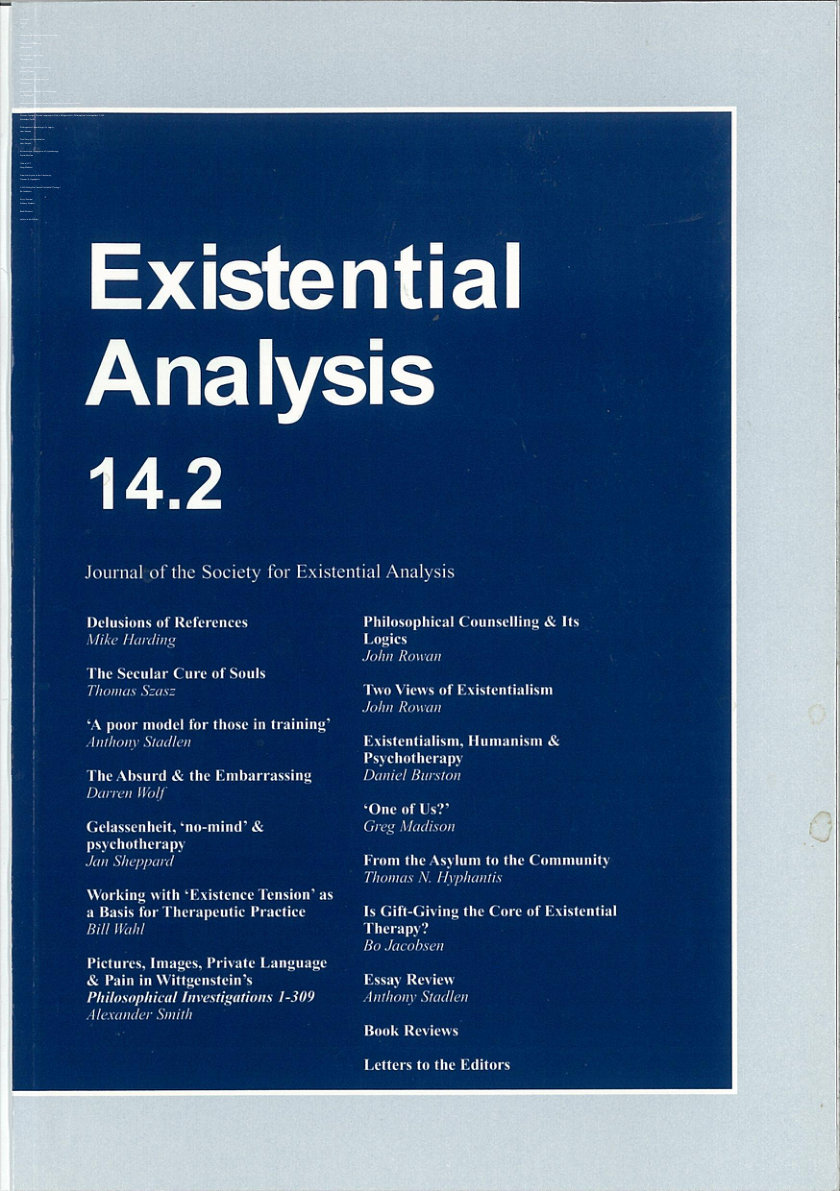
Philosophical Counselling and Its Logics
DOI:
https://doi.org/10.65828/f7xz4x15Complete access to the full archive of articles is available with SEA membership. Existing members: please log in with your membership password to view full text. Non-members can buy a single article or issue by registering an account on this website, then selecting a padlocked full text button to purchase.
References
Achenbach, G.B. (1995). Philosophy, philosophical practice and psychotherapy. In R. Lahav & M. da V. Tillmanns (eds) Essays on Philosophical Counselling. Lanham: University Press of America.
Adam, A. (2001). A concept of progress as embedded in the logic of questions in philosophical practice. In T. Curnow (ed). Thinking Through Dialogue: Essays on Philosophy in Practice. Oxted: Practical Philosophy Press.
Borowicz, J. (2001). Philosophical practice and the emergence of the dialogical self. In T. Curnow (ed). Thinking Through Dialogue: Essays on Philosophy in Practice. Oxted: Practical Philosophy Press.
Browning, D. (ed). (1965). Philosophers of Process. New York: Random House.
Bugental, J.F.T. (1987). The Art of the Psychotherapist. New York: W.W Norton.
Clarkson, P. (2002). On Psychotherapy 2. London: Whurr.
Cohen, E.D. (1995). Philosophical counselling: Some roles of critical thinking. In R. Lahav & M. da V. Tillmanns (eds). Essays on Philosophical Counselling. Lanham: University Press of America.
Dryden, W. (2000). Rational emotive behaviour therapy. In C. Feltham & I. Horton (eds). Handbook of Counselling and Psychotherapy. London: Sage. DOI: https://doi.org/10.4324/9780429467066-1
Feldmar, A. (1997). Contribution. In B. Mullan (ed). R.D. Laing: Creative Destroyer. London: Cassell, 340-368.
Field, N. (1996). Breakdown and Breakthrough: Psychotherapy in a New Dimension. London: Routledge.
Fleming, J. (2001). Philosophical counselling and Chuang Tsu's philosophy of love. In T. Curnow (ed). Thinking Through Dialogue: Essays on Philosophy in Practice. Oxted: Practical Philosophy Press.
Glover, J. (1988). I: The Philosophy and Psychology of Personal Identity. London: Allen Lane. DOI: https://doi.org/10.2307/2215959
Honos-Webb, L., Sunwolf & Shapiro, J.L. (2001). Toward the re-enchantment of psychotherapy: Stories as container. The Humanistic Psychologist 29/1-3 70-97. DOI: https://doi.org/10.1080/08873267.2001.9977008
Hycner, R. (1993). Between Person and Person: Toward a Dialogical Psychotherapy. Highland: The Gestalt Journal Press.
Joachim, H.H. (1948). Logical Studies. Oxford: Clarendon Press.
LeBon, T. (2001). Wise Counselling. London: Continuum.
Mahrer, A.R. (1989). Experiencing: A Humanistic Theory of Psychology and Psychiatry. Ottawa: University of Ottawa Press.
Marinoff, L. (1995). On the emergence of ethical counselling: Considerations and two case studies. In R. Lahav & M. da V. Tillmanns (eds). Essays on Philosophical Counselling. Lanham: University Press of America. DOI: https://doi.org/10.4135/9781473910867.n8
Marinoff, L. (1999). Plato Not Prozac!: Applying Philosophy to Everyday Problems. New York: HarperCollins.
May, R. (1972). Power and Innocence: A Search for the Sources of Violence. New York: W W Norton.
May, R. (1983). The Discovery of Being. New York: W W Norton.
Mearns, D. & Thorne, B. (2000). Person-Centred Therapy Today: New Frontiers in Theory and Practice. London: Sage.
Parfit, D. (1984). Reasons and Persons. Oxford: Clarendon Press. DOI: https://doi.org/10.1093/019824908x.001.0001
Raabe, P. (2002). The life examined in philosophical counselling. Practical Philosophy 5/1 20-27.
Rowan, J. (1990). Subpersonalities: The People Inside Us. London: Routledge.
Rowan, J. (1992). Hegel and self-actualisation. In Breakthroughs and Integration in Psychotherapy. London: Whurr.
Rowan, J. (1993). The Transpersonal: Counselling and Psychotherapy. London: Routledge.
Rowan, J. (1998). Linking: Its place in therapy. International Journal of Psychotherapy 3/3 245-254.
Rowan, J. (2000). Dialectical thinking and humanistic psychology. Practical Philosophy 3/2 18-21.
Rowan, J. & Cooper, M. (eds). (1999). The Plural Self: Multiplicity in Everyday Life. London: Sage.
Rowan, J. & Jacobs, M. (2002). The Therapist's Use of Self. Buckingham: Open University Press.
Schneider, K.J. (1998). Existential processes. In I.S. Greenberg, J.C. Watson & G. Lietaer (eds). Handbook of Experiential Psychotherapy. New York: Guilford Press.
Screenivason, R., Pradhan, N. and Rapp, P. (Eds.), (1999). Nonlinear Dynamics and Brain Functioning. Huntington, New York: Nova Science.
Shibbles, W. (2001). The philosophical practitioner and emotion. In T. Curnow (ed). Thinking Through Dialogue: Essays on Philosophy in Practice. Oxted: Practical Philosophy Press.
Shotter, J. (1999). Life inside dialogically structured mentalities: Bakhtin's and Voloshinov's account of our mental activities as out in the world between us In J. Rowan & M. Cooper (eds). The Plural Self: Multiplicity in Everyday Life. London: Sage.
Stecker, B. & Grimes, P. (2001). Symmetry and the origin of the pathologos in philosophical midwifery. In T. Curnow (ed). Thinking Through Dialogue: Essays on Philosophy in Practice. Oxted: Practical Philosophy Press.
Walton, S. (2002). The nature and the pursuit of happiness. Practical Philosophy 5/1 40-54.
Warren, D.D. (2001). Healing Thrasymachus: The psychotherapeutic use of dialogue. In T. Curnow (ed). Thinking Through Dialogue: Essays on Philosophy in Practice. Oxted: Practical Philosophy Press.
Wilber, K. (1995). Sex, Ecology, Spirituality. Boston: Shambhala.
Wilber, K. (1997). The Eye of Spirit. Boston: Shambhala.
Wilber, K. (2000). Integral Psychology. Boston: Shambhala.
Wolfert, R. (1996). The broken doll: A survivor's journey into life. In B. Feder & R. Ronald (eds). A Living Legacy of Fritz and Laura Perls: Contemporary Case Studies. Monclair: Self-Published. DOI: https://doi.org/10.2307/44394070