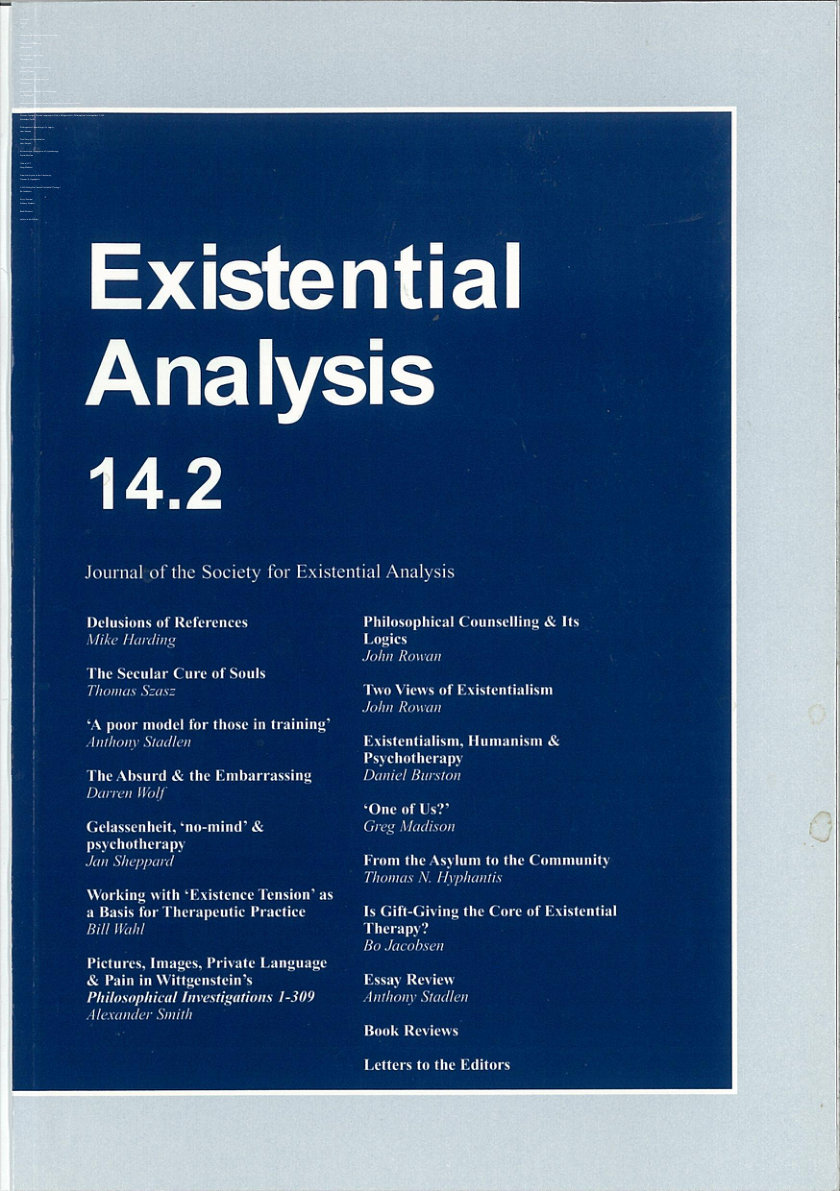
'A poor model for those in training' The case of Thomas Szasz
DOI:
https://doi.org/10.65828/t8px0q23Complete access to the full archive of articles is available with SEA membership. Existing members: please log in with your membership password to view full text. Non-members can buy a single article or issue by registering an account on this website, then selecting a padlocked full text button to purchase.
References
Acton, John E. E. D. (1988) Essays in Religion, Politics, and Morality. (Edited by J. Rufus Fears.) Indianapolis, IN: Liberty Classics.
Bearn, Gordon C. F. (1997). Waking to Wonder: Wittgenstein's Existential Investigations. Albany, NY: State University of New York Press.
Binswanger, Ludwig (1947a [1946]). Über die daseinsanalytische Forschungsrichtung in der Psychiatrie. In: Binswanger 1947b: 190–217.
Binswanger, Ludwig (1947b). Ausgewählte Vorträge und Aufsätze, Band 1. Bern: Francke.
Binswanger, Ludwig (1957a [1945]). Wahnsinn als lebensgeschichtliches Phänomen und als Geisteskrankheit': Der Fall Ilse. In: Binswanger 1957b: 29–55.
Binswanger, Ludwig (1957b). Schizophrenie. Pfullingen: Günther Neske.
Binswanger, Ludwig (1958a [1946]). The existential analysis school of thought. In: May, Angel and Ellenberger 1958: 191–213. DOI: https://doi.org/10.1037/11321-007
Binswanger, Ludwig (1958b [1945]). Insanity as life-historical phenomenon and as mental disease: The case of Ilse. In: May, Angel and Ellenberger 1958: 214–236. DOI: https://doi.org/10.1037/11321-008
Boss, Medard (1963 [1957]). Psychoanalysis and Daseinsanalysis. New York: Basic Books.
Boss, Medard (1975 [1971]). Grundriss der Medizin und der Psychologie: Ansätze zu einer phänomenologischen Physiologie, Psychologie, Pathologie, Therapie und zu einer daseinsgemässen Präventiv-Medizin in der modernen Industrie-Gesellschaft. (Second edition.) Bern, Stuttgart, Wien: Hans Huber.
Boss, Medard (1979 [1975]). Existential Foundations of Medicine and Psychology. New York and London: Jason Aronson.
Burston, Daniel (1993). Book review: Louis A. Sass, Madness and Modernism. Journal of the Society for Existential Analysis, 3: 135–137.
Camus, Albert (1956). The Rebel: An Essay on Man in Revolt. New York: Vintage Books.
Camus, Albert (1961). Resistance, Rebellion, Death. New York: Alfred A. Knopf.
Cohn, Hans W. (1992). A response to Thomas Szasz. Journal of the Society for Existential Analysis, 3: 24–25. DOI: https://doi.org/10.65828/705q5f39
Cohn, Hans W. (1997). Book review: Emmy van Deurzen-Smith, Everyday Mysteries: Existential Dimensions of Psychotherapy. Journal of the Society for Existential Analysis, 8.2: 184–190.
Cohn, Hans W. (1997). Existential Thought and Therapeutic Practice. London: Sage.
Cohn, Hans W. (1998). Book review: Zbigniew Kotowicz, R. D. Laing and the Paths of Anti-Psychiatry. Journal of the Society for Existential Analysis, 9.2: 134–136. DOI: https://doi.org/10.4324/9780203978726
Cohn, Hans W. (2003). Personal communication (telephone), 7 May 2003.
Cooper, David G. (1978) The Language of Madness. London: Allen Lane.
Davis, Rupert (1996). An existential analysis of the Royal Song of Saraha. Journal of the Society for Existential Analysis, 7.1: 77–89. DOI: https://doi.org/10.65828/yfarmj21
Du Plock, Simon (1993). Dialogue or diatribe? A brief comparison of the implications for client-therapist interaction of existential and cognitive-analytic approaches. Journal of the Society for Existential Analysis, 4: 91–107. DOI: https://doi.org/10.65828/mn9pd655
Du Plock, Simon (1995). Smoke without fire: Towards an existential-phenomenological perspective on hallucinations. Journal of the Society for Existential Analysis, 6.2: 97–116. DOI: https://doi.org/10.65828/9g6crg63
Eliot, T. S. (1959 [1943]). Four Quartets. London: Faber and Faber.
Esterson, Aaron (1976). Anti-Psychiatry. (Letter.) The New Review, Vol. 3 No. 32 (November 1976): 70–71.
Fanon, Frantz (1967 [1961]). The Wretched of the Earth. Harmondsworth: Penguin Books.
Frankl, Viktor E. (1969). 'Nothing but—': On reductionism and nihilism. Encounter, Vol. 23, No. 5 (194, November 1969): 51–61.
Freud, Sigmund (1960 [1901]). The Psychopathology of Everyday Life. In: The Standard Edition of the Complete Psychological Works of Sigmund Freud, Volume 6. London: The Hogarth Press and the Institute of Psycho-Analysis. DOI: https://doi.org/10.1037/10012-000
Freud, Sigmund (1958 [1913]). On beginning the treatment. In: The Standard Edition of the Complete Psychological Works of Sigmund Freud, Volume 12: 121–144. London: The Hogarth Press and the Institute of Psycho-Analysis. DOI: https://doi.org/10.5040/9798216381136
Groth, Miles (2002). Therapeutic revalidation in existential analysis. Existential Analysis, 13.1: 144–158. DOI: https://doi.org/10.65828/afq6tj33
Häberlin, Paul (1941). Der Mensch: Eine Philosophische Anthropologie. Zurich: Schweizer Spiegel Verlag.
Hayman, Ronald (1995 [1980]). Nietzsche: A Critical Biography. London: Phoenix Giants.
Heidegger, Martin (1962 [1927]). Being and Time. (Translated by John Macquarrie and Edward Robinson.) London: SCM Press.
Heidegger, Martin (1986 [1927]). Sein und Zeit. Tübingen: Max Niemeyer. DOI: https://doi.org/10.1524/9783050050171
Heidegger, Martin (1994 [1987]). Zollikon Seminare: Protorokolle – Zwiegespräche – Briefe. (Herausgegeben von Medard Boss). (Second edition.) Frankfurt am Main: Vittorio Klostermann.
Heidegger, Martin (1996 [1927]). Being and Time. (Translated by Joan Stambaugh.) Albany, NY: State University of New York Press.
Heidegger, Martin (2000a [1936]). Hölderlin and the essence of poetry. In: Heidegger 200b [1981]: 51–65.
Heidegger, Martin (2000b [1981]). Elucidations of Hölderlin's poetry. Amherst, NY: Humanity Books.
Heidegger, Martin (2001 [1994]). Zollikon Seminars: Protocols – Conversations – Letters. (Edited by Medard Boss). Evanston, IL: Northwestern University Press.
Hetherington, Hugh (2001). Aspects of finitude (comprehension and apprehension). Existential Analysis, 12.1: 136–153. DOI: https://doi.org/10.65828/6637rn82
Hetherington, Hugh (2002). Comprehension and apprehension: Lucidity and existence tension. Existential Analysis. 13.2: 221–236. DOI: https://doi.org/10.65828/h17p4686
Hoeller, Keith (1996). The Tragedy of Psychology: Rollo May's daimonic and Friedrich Nietzsche's Dionysian. Journal of the Society for Existential Analysis. 7.1: 39–55. DOI: https://doi.org/10.65828/wewd7009
Jonathon, Arthur (1992). A summary of 'Taking dialogue as therapy seriously' – a talk delivered by Professor Thomas Szasz to the fourth annual conference of the S.E.A. Journal of the Society for Existential Analysis, 3: 10–14.
Kierkegaard, Søren (1959). The Journals of Kierkegaard (1835–1854) Edited and with an Introduction by Alexander Dru. New York: Harper Torchbooks.
Kierkegaard, Søren (1965). The Last Years: Journals, 1853–1855. London: Collins.
Kierkegaard, Søren (1978). Søren Kierkegaard's Journals and Papers, Volume 5, Autobiographical, Part 1: 1829–1848. Bloomington, IN: Indiana University Press. DOI: https://doi.org/10.2979/3020.4.0
Kierkegaard, Søren (1980 [1849]). The Sickness unto Death: A Christian Psychological Exposition for Upbuilding and Awakening. Princeton, NJ: Princeton University Press.
Laing, R. D. (1967). The Politics of Experience and The Bird of Paradise. Harmondsworth: Penguin Books.
Laing, R. D. (1978). Conversations with Children. Harmondsworth: Penguin Books.
Laing, R. D. and Cooper, David G. (1964). Reason and Violence: A Decade of Sartre's Philosophy (1964). London: Tavistock.
Lemma, Alessandra (1992). Book review: Lawrie Reznek, The Philosophical Defence of Psychiatry. Journal of the Society for Existential Analysis, 3: 135–136. DOI: https://doi.org/10.4324/9780203981726
Lemma, Alessandra and Spinelli, Ernesto (1992). Editorial, Journal of the Society for Existential Analysis. 3: 1. DOI: https://doi.org/10.1002/9781119311003.ch16
Madison, Greg (2002). 'Illness' … and its human values. Existential Analysis, 13.1: 10–30. DOI: https://doi.org/10.65828/jhkwjb61
May, Rollo, Angel, Ernest and Ellenberger, Henri F. (ed.) (1958). Existence: A New Dimension in Psychiatry and Psychology. New York: Basic Books. DOI: https://doi.org/10.1037/11321-000
Milton, Martin (1999). Book review: Ian Parker, Eugenie Georgaca, David Harper, Terence McLaughlin and Mark Stowell-Smith, Deconstructing Psychopathology; and Ian Parker, Psychoanalytic Culture: Psychoanalytic Discourse in Western Society. Journal of the Society for Existential Analysis, 10.1: 134–137. DOI: https://doi.org/10.4135/9781446221563
Moja-Strasser, Lucia (1995). Musings from Hamburg. Journal of the Society for Existential Analysis, 6.1: 104–110.
Nietzsche, Friedrich (1994 [1878]). Human, All Too Human. London: Penguin Books.
Nietzsche, Friedrich (2001 [1887]). The Gay Science: With a Prelude in German Rhymes and an Appendix of Songs. Cambridge: Cambridge University Press. DOI: https://doi.org/10.1017/cbo9780511812088
Richter, Jean Paul Friederich (1845 [1796]). Flower, Fruit and Thorn Pieces: Or the Married Life, Death, and Wedding of the Advocate of the Poor, Firmian Stanislaus Siebenkás. Boston, MA: James Munroe and Company.
Ryle, Gilbert (1949). The Concept of Mind. London: Hutchinson. DOI: https://doi.org/10.4324/9780203875858
Sabbadini, Andrea (1992). Some comments on T. S. Szasz's 'Taking dialogue as therapy seriously'. Journal of the Society for Existential Analysis, 3: 26–29. DOI: https://doi.org/10.65828/cf6jmc08
Sartre, Jean-Paul (1957 [1936–1937]). The Transcendence of the Ego: An Existentialist Theory of Consciousness. New York: Noonday Press. DOI: https://doi.org/10.4324/9780203694367
Sartre, Jean-Paul (1960a [1948]). Intimacy and Other Stories. New York: Berkeley.
Sartre, Jean-Paul (1962 [1939]). Sketch for a Theory of the Emotions. London: Methuen. DOI: https://doi.org/10.4324/9781003572367-2
Sartre, Jean-Paul (1964a [1963]). Foreword. In: Laing and Cooper 1964: 7.
Sartre, Jean-Paul (1964b [1952]). Saint Genet: Actor and Martyr. London: W. H. Allen. DOI: https://doi.org/10.1017/cbo9780511779497.009
Sartre, Jean-Paul (1964c). The Words. New York: Braziller.
Sartre, Jean-Paul (1965 [1946]). Anti-Semite and Jew. New York: Schocken.
Sartre, Jean-Paul (1966 [1943]). Being and Nothingness: A Phenomenological Essay on Ontology. New York: Washington Square Books. DOI: https://doi.org/10.4324/9780429434013
Sartre, Jean-Paul (1967 [1961]). Preface. In: Fanon 1967 [1961]: 7–26.
Sartre, Jean-Paul (1976 [1960b]). Critique of Dialectical Reason. I. Theory of Practical Ensembles. London: NLB. DOI: https://doi.org/10.1017/cbo9780511779497.008
Spinelli, Ernesto (1993). Book review: Thomas S. Oltmanns, John M. Neale and Gerald D. Davidson, Case Studies in Abnormal Psychology (3rd Edition). Journal of the Society for Existential Analysis, 4: 153–154.
Spinelli, Ernesto (1997). Tales of Un-knowing: Therapeutic Encounters from an Existential Perspective. London: Duckworth. DOI: https://doi.org/10.1002/9781119311003.ch16
Spinelli, Ernesto (2003). Personal communication (telephone), 5 May 2003.
Stadlen, Anthony (2000a). Letter to the editors. Journal of the Society for Existential Analysis, 11.1: 63–68. DOI: https://doi.org/10.65828/0hyj9445
Stadlen, Anthony (2000b). Obituary: Aaron Esterson, 25 September 1923 – 15 April 1999. Journal of the Society for Existential Analysis, 11.1: 157–161. DOI: https://doi.org/10.65828/8wxsv386
Stadlen, Anthony (2000c). Thomas Szasz: Asking simple questions. Hermeneutic Circular: Newsletter of the Society for Existential Analysis, April 2000: 12–14.
Stadlen, Anthony (2003a). Essay review: Gion Condrau, Martin Heidegger's Impact on Psychotherapy. Existential Analysis, 14.1: 162–178. DOI: https://doi.org/10.65828/fqsra350
Stadlen, Anthony (2003b). Heidegger's Zollikon Seminars: The American translation. Existential Analysis, 14.2. DOI: https://doi.org/10.65828/253epn07
Stadlen, Naomi (2002). Book review: Tim Bond, Standards and Ethics for Counselling in Action. Existential Analysis, 13.2: 333–336.
Stadlen, Naomi and Stadlen, Anthony (to be published 2004). 'Till this moment, I never knew myself': Individual, family, and existential psychotherapy. In: van Deurzen and Arnold-Baker 2004.
Steiner, George (1982). The Tale of Three Cities. New Yorker, 22 November 1982: 186–195.
Szasz, Thomas and Elgart, S. (1947). The 'Schemm Regime' in the treatment of extreme congestive heart failure: A case report. Ohio State Medical Journal, 43 (Sept. 1947): 926–928.
Szasz, Thomas (1962 [1961]). The Myth of Mental Illness: Foundations of a Theory of Personal Conduct. London: Secker and Warburg. DOI: https://doi.org/10.2307/2218648
Szasz, Thomas (1965a). Psychiatric Justice. New York: Macmillan.
Szasz, Thomas (1971a [1970a]). The Manufacture of Madness: A Comparative Study of the Inquisition and the Mental Health Movement. London: Routledge and Kegan Paul.
Szasz, Thomas (1971b). The sane slave: An historical note on the use of medical diagnosis as justificatory rhetoric. American Journal of Psychotherapy, 25 (Apr. 1971): 228–239. DOI: https://doi.org/10.1176/appi.psychotherapy.1971.25.2.228
Szasz, Thomas (1973 [1970b]). Ideology and Insanity: Essays on the Psychiatric Dehumanization of Man. London: Calder and Boyars.
Szasz, Thomas (1974a [1961]). The Myth of Mental Illness: Foundations of a Theory of Personal Conduct. (Revised edition.) New York: Harper and Row, Perennial Library.
Szasz, Thomas (1974b). Ceremonial Chemistry: The Ritual Persecution of Drugs, Addicts, and Pushers. Garden City, NY: Doubleday Anchor.
Szasz, Thomas (1975a). Preface, 1975. In: Szasz 1975c [1957]: v–ix.
Szasz, Thomas (1975b). Pain in a new perspective, 1975. In: Szasz 1975c [1957]: xi–xlvii.
Szasz, Thomas (1975c [1957]). Pain and Pleasure: A Study of Bodily Feelings (Second Expanded Edition). New York: Basic Books.
Szasz, Thomas S. (1976a). Anti-Psychiatry: The Paradigm of the Plundered Mind. The New Review, Vol. 3 No. 29 (August 1976): 3–14.
Szasz, Thomas (1977a [1976b]). Karl Kraus and the Soul-Doctors: A Pioneer Critic and His Criticism of Psychiatry and Psychoanalysis. London and Henley: Routledge and Kegan Paul.
Szasz, Thomas (1977b). Psychiatric Slavery. London: Collier Macmillan. DOI: https://doi.org/10.1176/pn.38.18.0028
Szasz, Thomas (1978a). Pilgrim's regress. The Spectator, 23 September 1978: 72–73.
Szasz, Thomas (1979a [1976c]). Schizophrenia: The Sacred Symbol of Psychiatry. Oxford: Oxford University Press.
Szasz, Thomas (1979b [1978b]). The Myth of Psychotherapy: Mental Healing as Religion, Rhetoric, and Repression. Oxford: Oxford University Press. DOI: https://doi.org/10.2307/j.ctvfjd13n
Szasz, Thomas (1984). The Therapeutic State: Psychiatry in the Mirror of Current Events. Buffalo, NY: Prometheus Books.
Szasz, Thomas (1987). Insanity: The Idea and Its Consequences. New York: Wiley.
Szasz, Thomas (1988 [1965b]). The Ethics of Psychoanalysis. Syracuse, NY: Syracuse University Press.
Szasz, Thomas (1989). Videotape of 'Practical implications of The Myth of Mental Illness for psychotherapy', a seminar with the Society for Existential Analysis, 11 February 1989.
Szasz, Thomas (1990a). On The Ethics of Psychoanalysis. Journal of the Society for Existential Analysis, 1: 63–66. DOI: https://doi.org/10.65828/ft41e079
Szasz, Thomas (1990b [1976b]). Anti-Freud: Karl Kraus's Criticism of Psychoanalysis and Psychiatry. Syracuse, NY: Syracuse University Press.
Szasz, Thomas (1991a). Transcript of 'Taking dialogue as therapy seriously', talk to the Fourth Annual Conference of the Society for Existential Analysis, 14 December 1991.
Szasz, Thomas (1991b). Videotape of 'Taking dialogue as therapy seriously', and of discussion, including panel discussion, at the Fourth Annual Conference of the Society for Existential Analysis, 14 December 1991.
Szasz, Thomas (1992). Taking dialogue as therapy seriously: 'Words are the essential tool of treatment'. Journal of the Society for Existential Analysis, 3: 2–9. DOI: https://doi.org/10.65828/vptvmw31
Szasz, Thomas (1996). The Meaning of Mind: Language, Morality, and Neuroscience. Westport, CT and London: Praeger.
Szasz, Thomas (1999). Fatal Freedom: The Ethics and Politics of Suicide. Westport, CT and London: Praeger.
Szasz, Thomas (2001). Pharmacracy: Medicine and Politics in America. Westport, CT and London: Praeger.
Szasz, Thomas (2002a). Liberation by Oppression: A Comparative Study of Slavery and Psychiatry. New Brunswick, NJ and London: Transaction Publishers. DOI: https://doi.org/10.4324/9780203787182
Szasz, Thomas (2002b). Personal communication (email), 18 July 2002.
Szasz, Thomas (2003) Personal communication (email), 12 March 2003.
Ticktin, Stephen J. (2000 [1989]) Practical implications of The Myth of Mental Illness for psychotherapy: A seminar with Thomas Szasz. Hermeneutic Circular: Newsletter of the Society for Existential Analysis, April 2000: 14–15.
Twain, Mark (n.d. [1885]). Huckleberry Finn. London: Heirloom Library.
Van Artsdalen, Carole and Zanger, Elena Lea (1990a). Editorial. Journal of the Society for Existential Analysis, 1: 1.
Van Artsdalen, Carole and Zanger, Elena Lea (1990b). Editors' Note [to Szasz 1990a]. Journal of the Society for Existential Analysis, 1: 63.
van Deurzen-Smith, Emmy (1992). Dialogue as therapy. Journal of the Society for Existential Analysis, 3: 15–23. DOI: https://doi.org/10.65828/vkkcxx09
van Deurzen, Emmy (2003). Personal communication (telephone), 30 April 2003.
Wiesenhütter, Eckart (1979). Die Begegnung zwischen Philosophie und Tiefenpsychologie. Darmstadt: Wissenschaftliche Gesellschaft.
Wolf, Darren (2002). Nietzsche's psychopathology. Existential Analysis, 13.2: 297–308. DOI: https://doi.org/10.65828/18ggnv15
Young, Sarah (1995). Inventing reality: Radical constructivism and phenomenology. Journal of the Society for Existential Analysis, 6.1: 96–104.
Zaner, Richard M. (1964). The Problem of Embodiment: Some Contributions to a Phenomenology of the Body. The Hague: Martin Nijhoff.