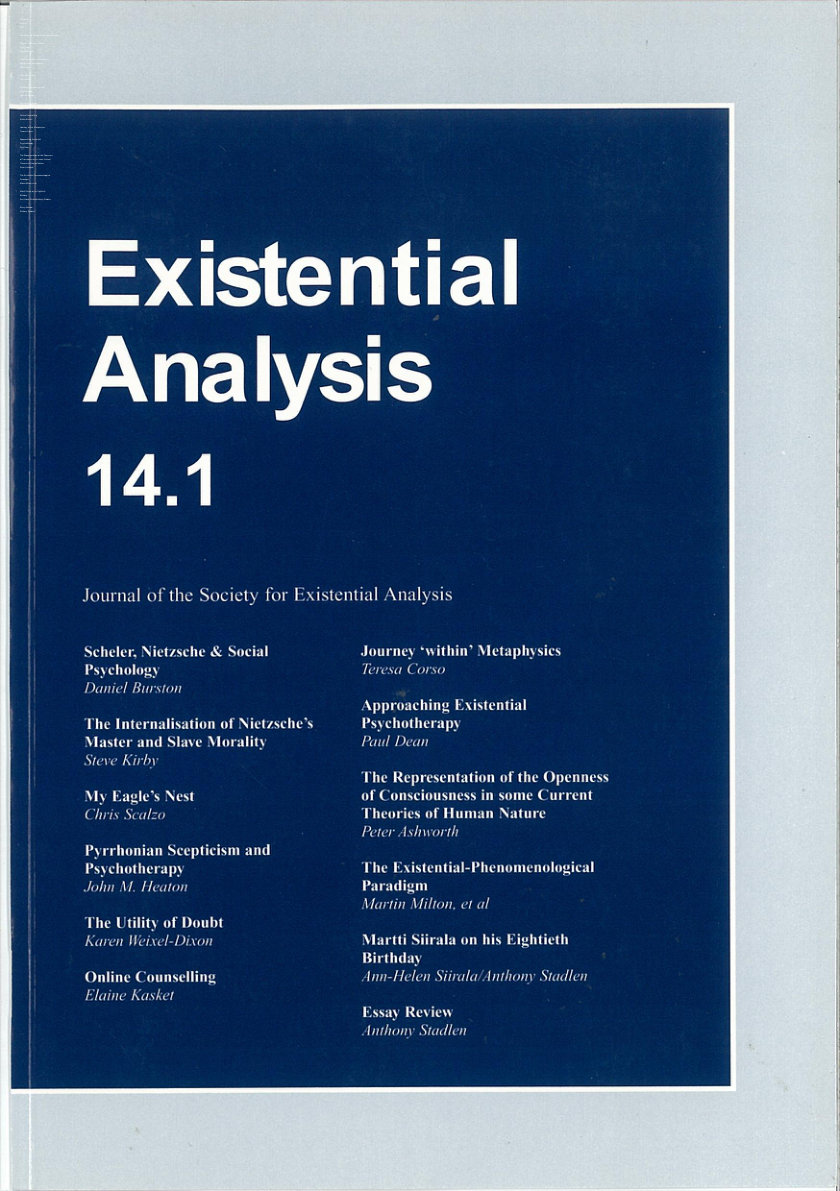
The Representation of the Openness of Consciousness in some Current Theories of Human Nature
DOI:
https://doi.org/10.65828/9we8kt19Abstract
The openness of consciousness, particularly pivotal to Sartre's early philosophy, gives immense difficulty to those who wish to give a comprehensive account of human nature. In this paper I note the treatment of human awareness of the world in some current theories: The issue (as Merleau-Ponty pointed out) is one of giving due weight both to the creativity of consciousness – its ordinary productivity – and to the connectedness of awareness to the events of the world. This dual structure of openness has not been fully captured by contemporary theories.
Complete access to the full archive of articles is available with SEA membership. Existing members: please log in with your membership password to view full text. Non-members can buy a single article or issue by registering an account on this website, then selecting a padlocked full text button to purchase.
References
Ashworth, P.D. (1979). Social Interaction and Consciousness. Chichester: Wiley.
Ashworth, P.D. (1981). Equivocal alliances of phenomenological psychologists. Journal of Phenomenological Psychology, 12 , 1-31. DOI: https://doi.org/10.1163/156916281x00010
Ashworth, P.D. (1985). L'enfer, c'est les autres: Goffman's Sartrism. Human Studies, 8, 97-168. DOI: https://doi.org/10.1007/bf00144110
Ashworth, P.D. (2000). Psychology and 'Human Nature'. London: Routledge. DOI: https://doi.org/10.4324/9780203133200
Bartlett, F.C. (1932). Remembering. A Study in Experimental and Social Psychology. Cambridge: Cambridge University Press.
de Beauvoir, S. (1984). Adieux: A Farewell to Sartre. London: Penguin.
de Beauvoir, S. (1988). The Second Sex. London: Pan Books.
Craik, K.J.W. (1943). The Nature of Explanation. Cambridge: Cambridge University Press.
Edwards, D & Potter, J. (1992). Discursive Psychology. London: Sage.
Foucault, M. (1972). The Archaeology of Knowledge. London: Tavistock. DOI: https://doi.org/10.4324/9780203604168
Foucault, M. (1973). The Order of Things: An Archaeology of the Human Sciences. New York: Vintage. DOI: https://doi.org/10.4324/9781315660301
Freud, S. (1976). The Interpretation of Dreams. (Pelican Freud Library Vol 4). Harmondsworth: Penguin. DOI: https://doi.org/10.1093/owc/9780199537587.001.0001
Giorgi, A.P. (1981). Sartre's systematic psychology. In Schilpp, P.A. (ed, 1981) The Philosophy of Jean-Paul Sartre. La Salle, Ill., Open Court (pp 179-196). DOI: https://doi.org/10.1017/s1358246100004197
Goffman, E. (1971). The Presentation of Self in Everyday Life. Harmondsworth: Penguin.
Harré, R. & Gillett, G. (1994). The Discursive Mind. London: Sage. DOI: https://doi.org/10.4135/9781452243788
Howells, C. (1992). Sartre and the deconstruction of the subject. In C Howells (ed, 1992) The Cambridge Companion to Sartre. Cambridge: Cambridge University Press (pp 318-352). DOI: https://doi.org/10.1017/ccol0521381142
Kelly, G.A. (1955). The Psychology of Personal Constructs (2 volumes). New York: Norton. DOI: https://doi.org/10.4324/9780203359037
Mead, G.H. (1934). Mind, Self and Society. Chicago: Chicago University Press Press. DOI: https://doi.org/10.7208/chicago/9780226112879.001.0001
Merleau-Ponty, M. (1962). Phenomenology of Perception. London: Routledge and Kegan Paul
Merleau-Ponty, M. (1963). The Structure of Behaviour. London: Methuen.
Neisser, U. (1967). Cognitive Psychology. New York: Appleton-Century-Crofts. DOI: https://doi.org/10.4324/9781315736174
Potter, J. & Wetherell, M. (1987). Discourse and Social Psychology: Beyond Attitudes and Behaviour. London: Sage.
Ricoeur, P. (1970). Freud and Philosophy: An essay on interpretation. New Haven: Yale University Press.
Ricoeur, P. (1971). The model of the text: Meaningful action considered as text. Social Research, 38, 527-562. DOI: https://doi.org/10.2307/468410
Ricoeur, P. (1998). Critique and Conviction. Cambridge: Polity Press.
Sartre, J.-P. (1957). The Transcendence of the Ego. New York: Farrar, Straus and Giroux. DOI: https://doi.org/10.4324/9780203694367
Sartre, J.-P. (1958). Being and Nothingness. New York: Philosophical Library. DOI: https://doi.org/10.2307/2182625
Sartre, J.-P. (1962). Sketch for a Theory of the Emotions. London: Methuen. DOI: https://doi.org/10.4324/9781003572367-2
Schilpp, P.A. (ed, 1981). The Philosophy of Jean-Paul Sartre. La Salle, Ill.: Open Court.
Skinner, B.F. (1980). Notebooks. Englewood Cliffs, N.J.: Prentice Hall.
Skinner, B.F. (1993). About Behaviourism. London: Penguin.
Tooby, J. & Cosmides, L. (1992). The psychological foundations of culture. In J H Barkow, L Cosmides and J Tooby (1992) The Adapted Mind: Evolutionary Psychology and the Generation of Culture. New York: Oxford University Press (pp.19-136). DOI: https://doi.org/10.1093/oso/9780195060232.003.0002