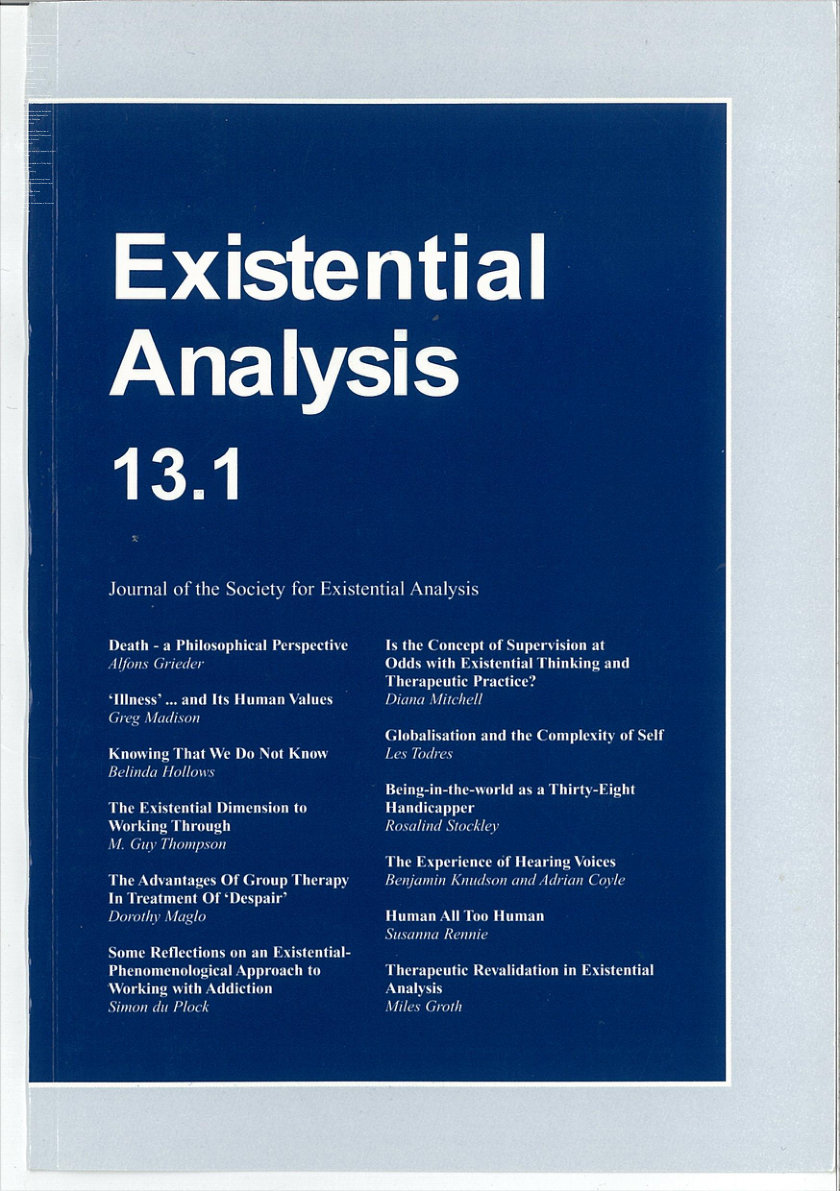
Therapeutic Revalidation in Existential Analysis
DOI:
https://doi.org/10.65828/afq6tj33Complete access to the full archive of articles is available with SEA membership. Existing members: please log in with your membership password to view full text. Non-members can buy a single article or issue by registering an account on this website, then selecting a padlocked full text button to purchase.
References
Martin Heidegger, Zollikon Seminars. Protocols–Conversations–Letters, edited by Medard Boss, translated by Franz Mayr and Richard Askay (Evanston: Northwestern University Press, 2001), p. 176.
Martin Heidegger, Sein und Zeit (Frankfurt: Klostermann, 1977), p. 163 (translation by John Macquarrie and Edward Robinson, Being and Time [New York: Harper, 1962], pp. 158-59). DOI: https://doi.org/10.1524/9783050050171
This may account for both the frustrations and satisfactions of existential analytic practice.
Martin Heidegger, Being and Time (New York: Harper and Row, 1962), pp. 158-59).
Marguerite Sechehaye, in Symbolic Realization (New York: International Universities Press, 1951) recounts her years-long effort with a woman diagnosed as schizophrenic, with whom Sechehaye seems to have accomplished what I have called reinvestiture of existence, although her involvement with the patient was at the very least maternal.