Editorial
Full Text
Welcome to this, the second edition of the thirty-second volume of Existential Analysis, which opens with three further papers from the 2020 Society for Existential Analysis Conference. Each author engages with the Conference theme, 'This Is Not What I Had Planned', and the impact of the COVID-19 pandemic in a different way. Chris Goto-Jones' paper provides an episodic narrative case study informed by philosophical counselling, while Maria Galani explores the phenomenon of workplace bullying – a phenomenon which she argues has become more frequent during the pandemic, especially in digital workplaces. Rafal Miętkiewicz discusses the use of the concept of a 'boundary situation' in existential therapy, reminding us that the pandemic is only one more example of a boundary situation.
We follow these papers with three research-based contributions. Phoebus Ebbini and Neil Lamont describe an IPA study of the meaning gay men on pre-exposure prophylaxis (PrEP) make of their sexuality; Natalie Lancer and Virginia Eatough also use IPA, this time to undertake an exploration of the experience of personal growth among university students. They develop what they call the Eight Tensions Framework, which they suggest is potentially useful and relevant to professionals beyond the HE context who view their clients as students of life. Claire Spiller returns to the theme of the COVID-19 pandemic in her paper, in which she expands on a number of existential themes which she initially expounded in the course of her collaboration with researchers on the project 'The challenges and experiences of psychotherapists working remotely during the coronavirus pandemic', completed in 2020. She includes an invitation to interested readers who may wish to contribute to further exploration of how existential practitioners are responding to existential crisis. As Editors we are glad to encourage readers to engage with authors in order to promote debate and research related to any aspect of existential-phenomenological theory and therapeutic practice.
Much has been written on existential therapeutic practice but, curiously, nothing until now has been written on existential pedagogy. This issue has two papers on the subject. The first, by Martin Adams, looks at the connections between existentialism, education and psychotherapy teaching. The second, by Simon du Plock, Martin Adams and Rosemary Lodge, arose out of a discussion the editors had with Rosemary Lodge and Zoe Gelis about their paper in the last issue. The starting point was an editorial request to clarify an exercise they had done. This led to a realisation of a shared but undiscussed preoccupation with teaching existential therapy. The resulting paper is a discussion and elucidation of some of the issues. As with Spiller's paper, the article concludes with a request for more research.
The next paper, by Rachel Noar, concerns the way in which, without external input, existential conceptualisations of schizophrenia can easily become constrained and polarised. Noar calls for greater communication with contemporary psychiatry.
Paul Overend's paper explores the nature and use of power in the therapeutic relationship, while Daniel Jones, starting from a first person perspective, explores the meaning of the trans experience with respect to its implications for therapeutic practice.
Our last paper is another of our occasional and polemical 'Thinking Aloud' pieces, in which Dominic Macqueen explores the ethics and practice of fitness-to-practice regulation.
This edition closes, as usual, with a number of stimulating and thought-provoking book reviews.
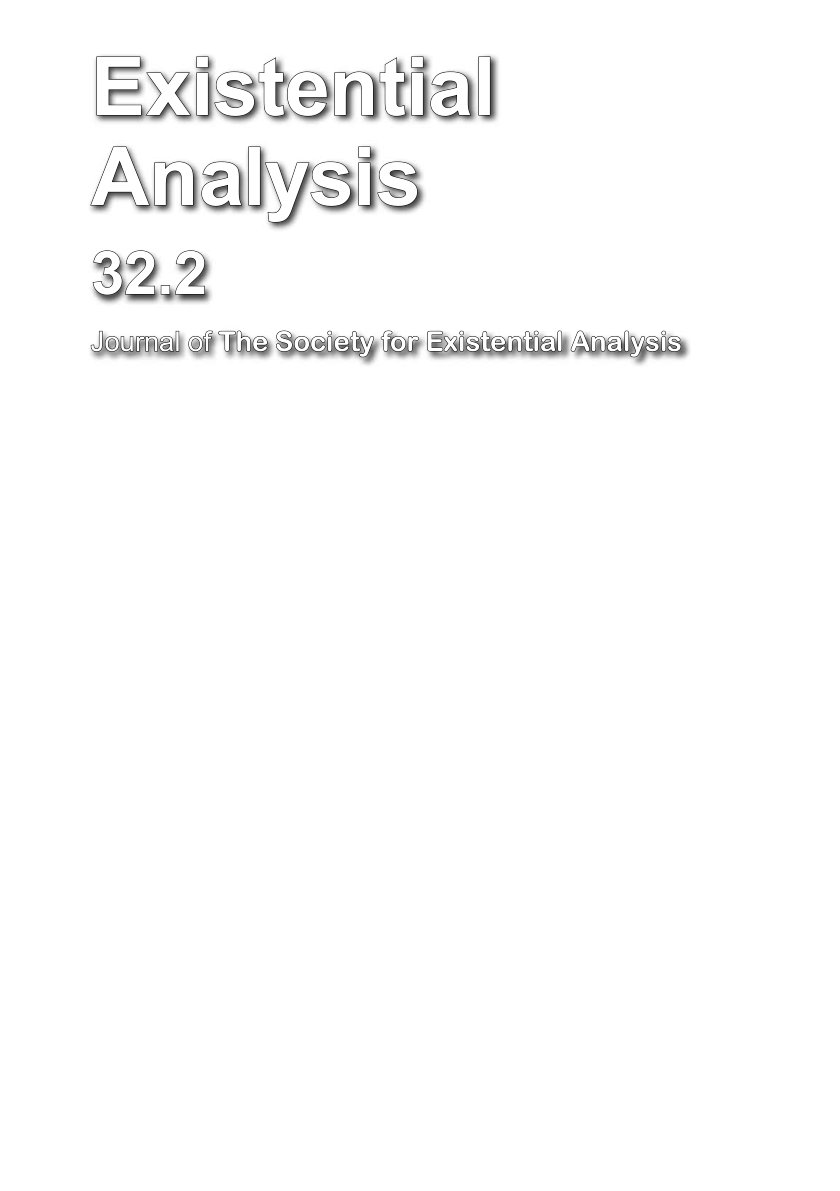
It has been our practice in recent years to vary the cover of each issue. Because of world events we made the cover of the last issue represent the possibility of a tabula rasa, out of which the world could possibly choose a new path. In the short time since then we have seen little that changes that view. The pandemic shows little sign of disappearing, neither does the need for action on climate change. Accordingly we have kept the same cover for this issue.
Prof Simon du Plock
Dr Martin Adams
References