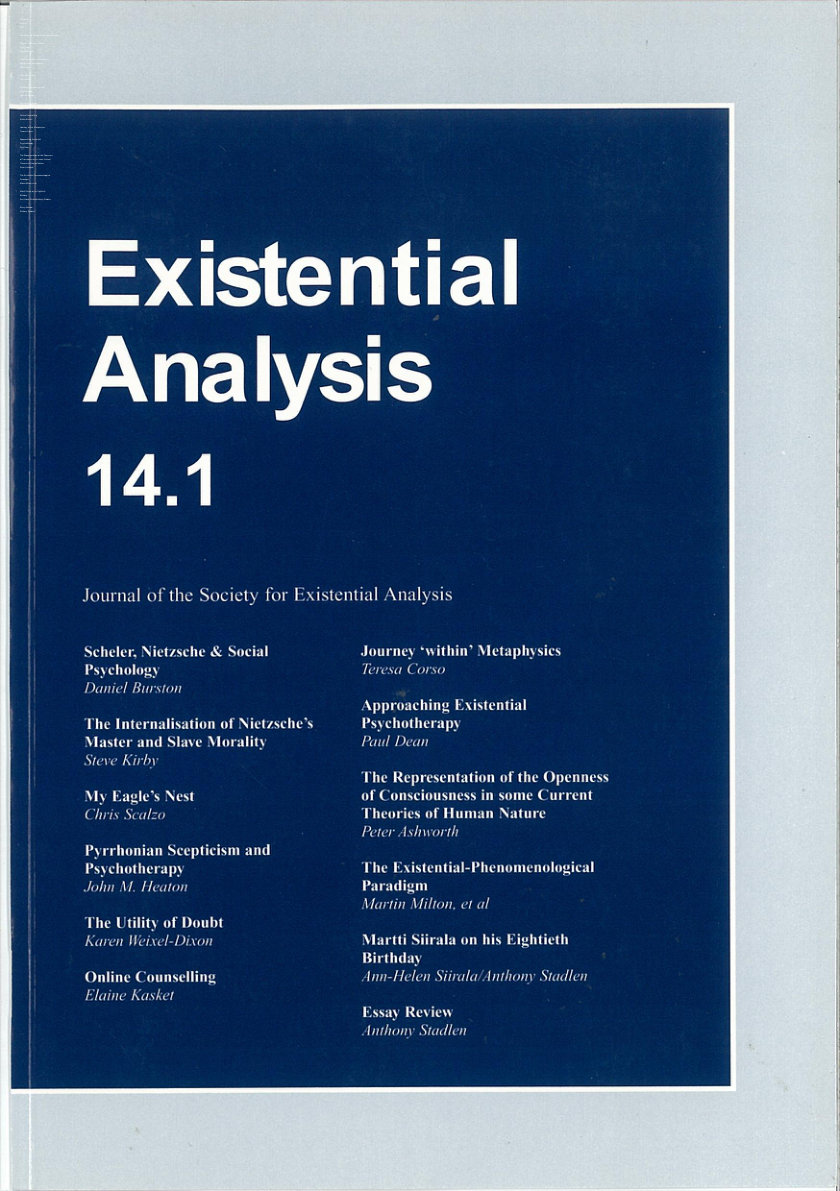
Book Review: Heidegger and the Roots of Existential Therapy
Full Text
Existential therapists rarely get the chance to read new books on existential psychotherapy that are firmly rooted in the philosophies that they draw from. Hans Cohn is one of a disappearing breed of practitioners who value the quiet thought and careful contemplation that make existential therapy into what it is: a very personal and reflective approach that addresses concrete and specific issues of human existence in a philosophical manner. We are fortunate to be able to reap the fruits of Hans Cohn's many long years of studying and thinking about his own therapeutic practice in light of the philosophy of Martin Heidegger. It is a pleasure to find a book on Heidegger that unashamedly announces its interest in practical application. This book tries to bridge the gap between a scholarly study of Heidegger devoid of any pragmatic understanding on the one hand and an existential therapy devoid of philosophical input on the other hand. I am wholeheartedly on Cohn's side when he takes up this almost impossible challenge. We know from Boss's remarks in the Zollikon seminars that Heidegger himself in the later years of his life fervently opted for such an attempt to apply his thinking. In spite of the important though often overrated distinction between ontological and ontic levels of description there comes a time when we must have the courage to bring the two levels of description together in the way in which Cohn has done in this book. I congratulate him on his achievement, which I think is very real. The book will be a valuable addition to the available literature for existential psychotherapists and I have already included it in my reading lists for New School students with the pleasure of knowing that students will get much out of reading it and will get a little closer to understanding Heidegger's relevance to psychotherapy. Cohn's writing, as always, is to the point and clear. He succeeds in highlighting some of the issues that are often misunderstood or confused and he does a good job in setting the record straight on a number of points, especially in relation to mistakes in German translation. I appreciate Cohn's knowledge and his way of grappling with the issues, although I inevitably disagree to some extent with his particular rendering of Heidegger's contribution to psychotherapy. I wish there were more existential psychotherapists who had his breadth of experience and grasp of the philosophical issues enabling them to truly debate such differences of opinion.
In his postscript to the book Cohn mentions how it was Heidegger's notion of Being-in-the-world that most significantly shifted his therapeutic perspective. He clarifies this by showing the importance of putting clients' material into context and seeking to understand always in a more complex manner what they are struggling with, rather than believing that a once off interpretation can be given.
My own way of understanding the human relation to Being as engagement and response has helped me to see that our difficulties are often not so much the result of conflicts 'within' ourselves, but are a reluctance or refusal to accept those aspects of Being, which can be as frightening and painful as they are real.
(p.127)
It is this search for engagement with life, allowing it to disclose itself ever more clearly, through our clients' concerns, through our own understanding of our clients' and our own preoccupations and experiences and through our study of philosophical writings such as those of Heidegger that seems to inspire Cohn's work. It is what makes Cohn's book most worth reading. This search is at best what Heidegger's work is also about. At worst however Heidegger's writing paradoxically hampers us in this engagement or this search, since his descriptions of the ontological dimension of human existence are rather more assertive and definitive than is warranted. Cohn does pay adequate attention to Heidegger's diversion into Nazism, but this short text does not leave much room to go into a critical analysis of Heidegger's contribution to psychotherapy and leaves a lot of room for potential idealization. It seems important to note that an authoritative fashion and who can easily be turned into an expert who preaches a dogma about human existence, is taught in a questioning and critical fashion. There is some of this questioning in the book, but most of all it is an account of Heidegger that praises his approach, accepts his findings and shows these to be invaluable to therapists. This I think is understandable in light of the fact that Cohn's objective in this book is to show Heidegger's relevance to therapy and make Heidegger accessible to those therapists who would not otherwise bother to read him. It means however that the book is most relevant to those who are beginning their training in existential psychotherapy, or to those who are practising therapists and have no existential background at all.
My greatest regret about the book is therefore not that it lacks a critical angle, but rather that it is a rather too brief and incomplete account of Heidegger's contribution. Hans Cohn has built his exposition of Heidegger's ideas around what is pragmatically useful to trainees and I think he has certainly succeeded in drawing on those ideas that are most accessible and perhaps most relevant to trainees. Yet at some points the book suffers from a lack of clarity about Heidegger's overall project and from a lack of completeness. I would have preferred to see a more systematic tackling of the issues and was surprised at some of the important aspects of Heidegger's descriptions of existence that have been left out. This is understandable because Heidegger's complexity is difficult to do justice to and this is a slim volume. Yet there is some cause for concern about potential confusion. For instance when Cohn singles out Being-in-the-world, this takes Heidegger's writing out of its context, since Being-in-the-world is only one of the elements of Dasein's thrown mode of being and it can only really be understood in light of the notions of projection and care. Care or Sorge as a fundamental underpinning characteristic of Dasein's existence is downplayed. The basic structures of Care and their modalities of Disposition (or Attunement), Understanding and Discourse and the existentials of Thrownness, Fallenness and Existence remain fairly loosely described. They do appear here and there in different places, but it is often unclear how it all fits together. The important issue of time and our struggle with constant projection into the future and retrieval of past, together with the temporal nature of human existence and the possibility of being in the situation and living in the moment (Augenblick) are also underplayed.
But it seems churlish to criticize this book for what it lacks when there is so much to absorb and relish here. Students will find Cohn's easygoing exposition of complex ideas enormously helpful. The summaries at the end of each chapter where he gives the main points of therapeutic relevance will be useful to many. They would provide an excellent basis for discussions on these topics. Most of all what I personally prize in the book is the tone of deferential pragmatism. There is genuineness and practical wisdom to be found in this short text that many longer, more scholarly books lack. Hans Cohn has given us a personal and valuable statement about the theoretical underpinnings of his work as a psychotherapist. There can be little doubt that his contribution to our thinking about practice is invaluable. His discussion of Heidegger's ideas is lively and fair. Whether we agree with Hans Cohn's rendering of Heidegger should be a topic for active debate rather than cause to judge his work. I know that Hans Cohn would gladly agree to be part of such a debate and that he certainly aimed to bring it about. If this book enables us to come a little closer to engaging with life and our different understandings of it, then it will have achieved its objective. I for one, think it does and hope it will for others.
Emmy van Deurzen
References